
How to find affordable nursing CEUs that count

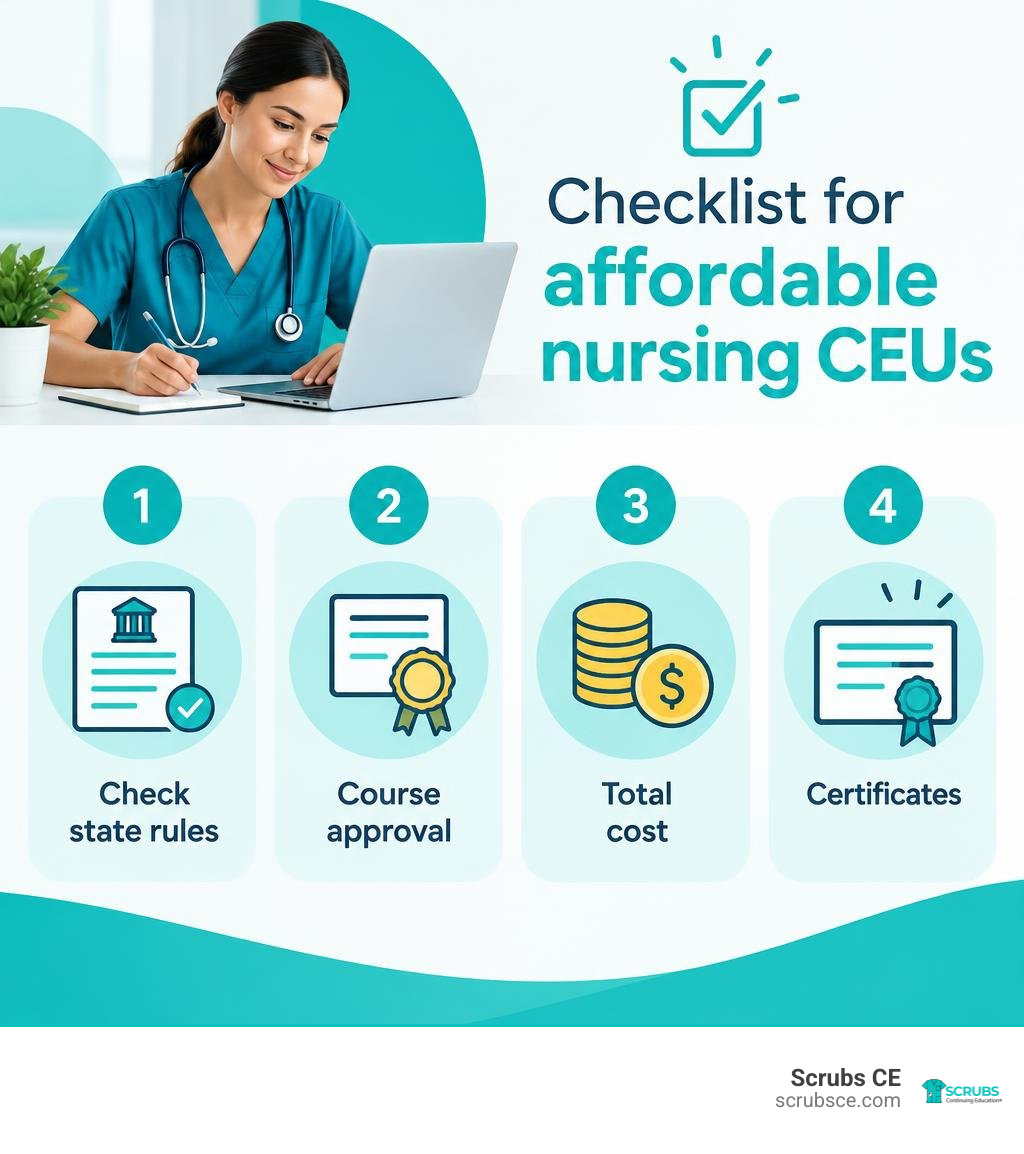
When you look for CEUs for nurses for less, check your state nursing board’s renewal rules before you pay. Note the required hours and topics, then confirm that the course and provider are accepted by your board. Compare the total cost for the hours you need, and make sure you’ll receive a certificate you can keep for your records.
I’m Zita Ewert, and I lead continuing education at SCRUBS CE, where my work has focused on affordable, self-paced courses for imaging professionals. That experience guides my approach to CEUs for nurses for less: check that a course counts before choosing it for its price. Prices vary widely, and a lower sticker price does not always mean a lower final bill once fees or bundles are considered. Verifying approval first can save money, time, and frustration if hours later turn out not to be accepted.
CEUs for nurses for less helpful reading:
CEUs for nurses for less: what the platform offers and how to assess it
Finding high-quality continuing education on a budget should never mean compromising on your professional credentials. As healthcare professionals, we understand that nursing schedules are demanding, , and unpredictable. Online platforms that provide self-paced, flexible continuing education enable you to complete your mandatory hours from anywhere—whether on a tablet during a break or on your laptop at home. For nurses working rotating shifts, night shifts, or multiple jobs, the ability to start, pause, and resume a course at any hour is often the deciding factor. You can review material in short sessions between shifts, revisit difficult sections, and complete posttests when you are most alert, rather than trying to fit a full day of classroom instruction into an already full schedule. This flexibility also helps nurses who care for family members at home or who live far from a campus or conference center.
When you evaluate platforms offering continuing education at reduced rates, look closely at their core catalog offerings. A robust provider delivers comprehensive modules covering diverse clinical areas, general compliance topics, and specialty-specific updates. Each completed course should issue an immediate certificate of completion that displays your name, contact hours awarded, completion date, and provider accreditation details. Reviewing the complete guide to accredited RN CEUs helps ensure you understand what accreditations your state board mandates before enrolling. It is also worth checking whether courses can be accessed on different devices, whether progress is saved automatically, and whether certificates are available immediately after completion. Those practical details can make the difference between a smooth renewal experience and one that creates extra work at the deadline.
How CEUs for nurses for less can support license renewal
Most state boards of nursing mandate between 20 and 30 continuing education contact hours every two-year renewal cycle. Fulfilling these renewal credits through traditional in-person seminars often involves costly registration fees, travel expenses, and scheduling headaches. Affordable online platforms simplify this process by breaking requirements into accessible modules that fit neatly into your off-shift hours.
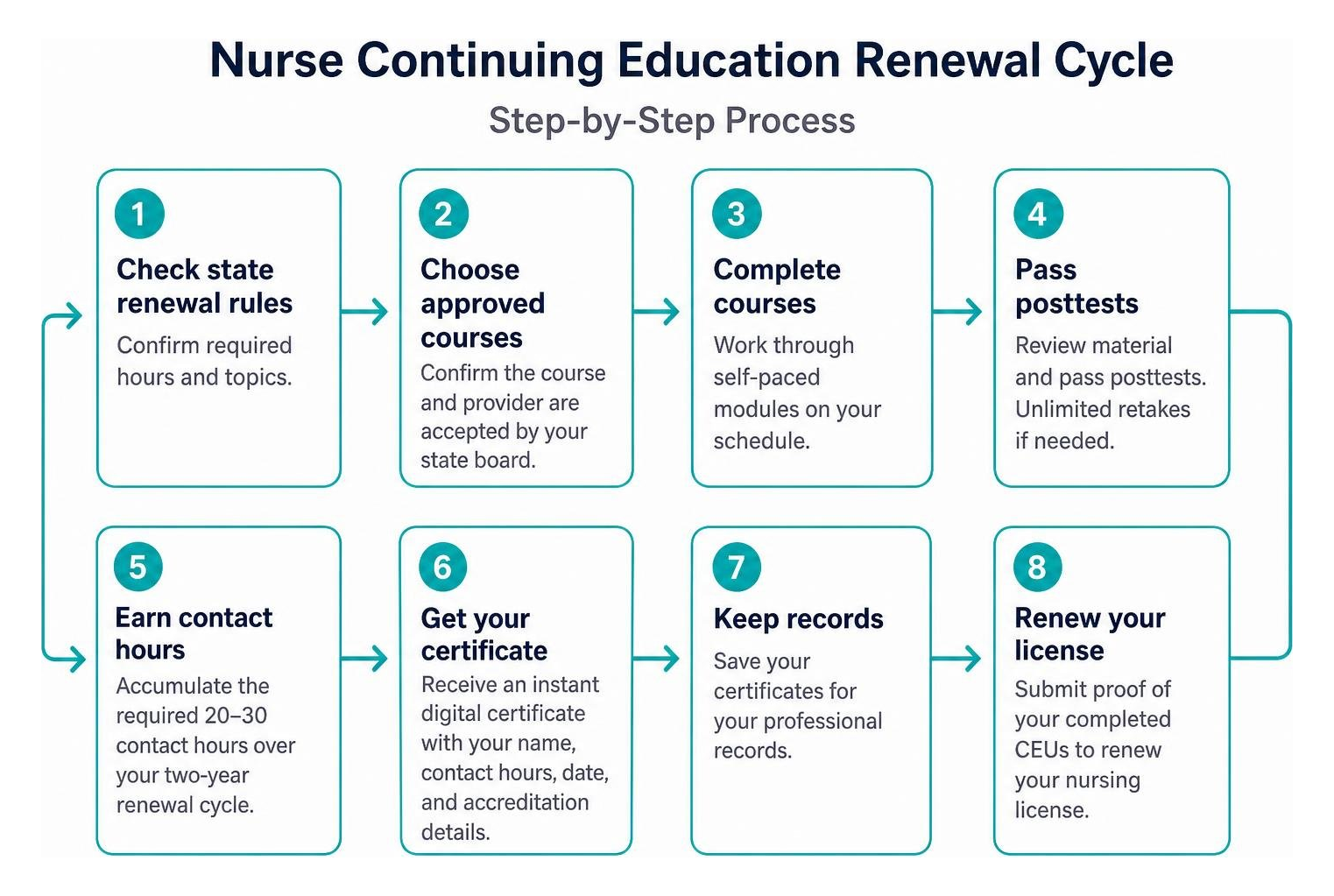
When selecting courses to maintain active licensure, review the posttest structure and documentation policies. Many platforms allow unlimited test retakes to ensure you achieve mastery of the material without paying secondary exam fees. Once you finish your coursework, instant digital certificate generation ensures you have immediate proof for your professional records. If you are preparing for an upcoming cycle, reading everything you need to know about completing your nursing CEU 30 hours will help streamline your renewal plan.
Which nursing topics to look for in the course catalog
State boards frequently mandate specific topic areas alongside general elective hours. When assessing an online course catalog, confirm that the provider covers both foundational requirements and specialty clinical topics:
- Mandatory state subjects: Infection control, implicit bias, medical errors prevention, ethics, jurisprudence, domestic violence, and pain management.
- Pharmacology and pharmacotherapeutics: Controlled substance prescribing, advanced pharmacology, and medication administration safety.
- Clinical care and safety: Critical care updates, fall prevention, emergency assessment, patient safety protocols, and wound care.
- Specialized nursing skills: Understanding specialized clinical areas, such as everything nurses need to know about IV therapy CE requirements, helps broaden clinical competency while fulfilling requirements.
Compare CEU costs, pricing models, and completion speed
According to research from the American Nurses Association, roughly 60% of nurses report that out-of-pocket costs represent a significant barrier to completing required continuing education. Individual courses can cost anywhere from $15 to $50 per credit hour, which quickly adds up when completing 30 contact hours. By taking advantage of affordable options, nurses save an average of $200 to $500 annually.
Providers generally package their education through three primary pricing structures: single-course purchases, bundled packages, and unlimited access subscriptions. For example, a nurse who needs only a few hours before a deadline may prefer a single targeted course, while a nurse renewing a license may save more with a bundle that covers every required topic in one purchase. Nurses with licenses in more than one state, or those who plan to take courses during the year, often find that an annual plan provides better value.
| Pricing Model | Average Cost Range | Best For | Advantages |
|---|---|---|---|
| Per-Course Purchase | $10 – $45 per module | Nurses needing 1–4 specific hours | Pay only for what you need; highly targeted |
| State-Specific Bundles | $25 – $60 per package | Standard two-year renewals (20–30 hrs) | Curated specifically to satisfy all state mandates |
| Annual Unlimited Access | $40 – $99 per year | Multi-state licenses or continuous learning | Complete unlimited online CEU credits at one fixed price |
When evaluating platforms, compare the final checkout price against the total contact hours awarded. Exploring affordable CE credits allows you to avoid overpriced single courses and secure packages that satisfy your exact state hour requirements without surprise add-on fees.
Verify course approval and your state’s nursing CEU requirements
Never purchase a continuing education course without first verifying provider approval and course acceptance with your state regulatory board. Each board maintains specific criteria regarding accepted accreditations, mandatory subjects, and allowable formats.

Many state nursing boards accept courses approved by national accreditation bodies, such as the ANCC continuing education accreditation system, state nursing associations, or other recognized healthcare licensing authorities. If you work in multidisciplinary settings or imaging departments, note that radiologic certifications through the AMERICAN REGISTRY OF RADIOLOGIC TECHNOLOGISTS® require adhering to specific ARRT® and ASRT® approved guidelines in Radiology. Keep a copy of the board page or approval information you reviewed, along with your certificates, so you can answer questions if your renewal is audited. Approval can change, so checking again at the start of each renewal cycle is safer than relying on what counted in a cycle.
Taking the time to review your state’s administrative code ensures your hours count seamlessly. Learn more about how to stay compliant and advance your career with the right CEU credits for nurses while fulfilling all regulatory benchmarks.
Assess course experience, support, and content quality before enrolling
A low price tag should never come at the expense of clear instruction, accurate evidence-based clinical guidelines, or reliable customer support. High-quality e-learning platforms ensure their interface is fully responsive across mobile phones, tablets, and desktop computers. Over 70% of nurses prefer online continuing education because it accommodates rotational shift schedules and variable sleep routines. Look for courses that explain concepts in plain language, use realistic clinical examples, and update their content to reflect current guidelines and practice standards. Clear headings, summaries, and learning objectives help you focus on the most important points, while well-written posttest questions should test understanding of the material rather than trick you with unclear wording. If a course feels outdated, disorganized, or difficult to navigate, that is a sign to consider another provider, even if the price is slightly higher. Responsive support is another important marker, because a quick answer about access, certificates, or state requirements can prevent delays when your renewal deadline is approaching.

Before paying for your courses, check for the following usability markers:
- Self-Paced Navigation: Ability to pause and resume reading modules without losing your progress.
- Accessible Customer Service: Available email or live chat support to resolve course access or account inquiries promptly.
- Instant Certificate Access: Automated generation of PDF certificates immediately following posttest completion.
- Peer Feedback and Reviews: Independent reviews and peer feedback verifying that the platform’s material is practical, modern, and easy to follow.
Reviewing a comprehensive guide on how to earn CE credits will give you a clear roadmap of what to expect during the course completion process.
How to choose CEUs for nurses for less without sacrificing quality
To ensure high educational quality on a budget, look for clear learning objectives at the beginning of each module. Content should be authored by qualified healthcare educators and clinicians, referencing current clinical research and established guidelines. For professionals seeking an alternative assessment approach, reading a practical guide to nursing CEUs: no test required explains how various educational formats assess competency.
What should nurses check before counting a course toward renewal?
Before submitting your course documentation for renewal or logging it in a state tracking portal, verify these essential details:
- Contact Hours Awarded: Ensure the certificate reflects the exact number of hours mandated by your board.
- Accreditation Statement: Confirm the approval body and provider identification number are printed clearly.
- Accurate Personal Information: Double-check that your full name, license number, and completion date match your state licensing records.
- Record Retention: Save both digital and printed copies of all certificates in your personal files in case of a random audit.
Conclusion
Finishing your nursing continuing education on time and on budget does not have to be stressful. By confirming your state board requirements in advance, choosing accredited coursework, and selecting transparent pricing models, you can complete your renewal credits efficiently. At Scrubs CE, we remain committed to providing healthcare professionals with convenient, high-quality, and self-paced continuing education. Planning ahead, rather than waiting until the last week of your renewal period, gives you time to compare options, confirm approval, and complete courses at a comfortable pace without rushing.
When you are ready to plan your upcoming license renewal, consult our 30-hour nursing CEU planning guide to ensure you meet every state requirement quickly and affordably.