

How Long Does It Take to Become an MRI Tech by Educational Pathway?
Becoming an MRI technologist typically takes between 6 months and 4 years, depending on your prior medical imaging experience and chosen educational pathway. For already-credentialed radiologic technologists, a post-primary certificate takes 6 to 12 months. Career changers and beginners can complete an accelerated certificate in 12 to 18 months, an associate degree in 18 to 24 months, or a four-year bachelor’s degree in 48 months.
Choosing the right educational path is the biggest factor determining your total time investment. Medical imaging offers multiple entry points depending on whether you are starting from high school, switching careers from an unrelated field, or already working in an imaging department.
When exploring CT and MRI Certificate Programs Near Me: Your Ticket to a High-Tech Career, you will find that program formats range from dedicated certificate tracks to complete collegiate degrees. Here is a clear comparison of your options:
| Educational Pathway | Typical Duration | Clinical Hours Required | Target Audience | Primary Credential Eligibility |
|---|---|---|---|---|
| Post-Primary Certificate | 6–12 Months | Structured Competencies (125+ procedures) | ARRT®-certified technologists (Radiography, Sonography, Nuclear Medicine) | ARRT® (MR) |
| Accelerated MRI Certificate | 12–18 Months | 750–1,000+ Hours | Career changers and non-imaging healthcare workers | ARMRIT / ARRT® (Primary if accredited) |
| Associate Degree (AAS in MRI) | 18–24 Months | 1,000–1,500 Hours | Beginners seeking an accredited college degree | ARRT® (MR) Primary / ARMRIT |
| Associate Degree (Radiography + MRI) | 2–3.5 Years | 1,500+ Radiography + Post-Primary MRI | Beginners wanting dual-modality career mobility | ARRT® (R) and ARRT® (MR) |
| Bachelor’s Degree (BS in Imaging) | 4 Years | 1,500+ Hours | Students pursuing imaging leadership and research | ARRT® (MR) Primary / ARMRIT |
Primary Pathway Associate Degree (18–24 Months)
An Associate of Applied Science (AAS) in Magnetic Resonance Imaging is a direct-entry option for newcomers who want a formal collegiate credential. Instead of spending two years learning diagnostic X-ray first, you focus directly on magnetic resonance imaging physics, patient safety, cross-sectional anatomy, and clinical rotations from the start.
To build foundational knowledge before your first day of class, reviewing MRI Training 101: Learn MRI Basics can help demystify core concepts like magnetic fields and radiofrequency pulses. Programs accredited by the Joint Review Committee on Education in Radiologic Technology (JRCERT) ensure your coursework qualifies you directly for the ARRT® Primary Eligibility Pathway upon graduation.
Post-Primary Pathway for Certified Technologists (6–12 Months)
If you are already an ARRT®-credentialed radiographer, nuclear medicine technologist (via ARRT® or NMTCB), or diagnostic medical sonographer (via ARRT® or ARDMS), you have the fastest route available. The post-primary pathway allows you to cross-train without enrolling in a full multi-year degree program.
This track requires completing 16 hours of structured education across MRI safety, patient care, imaging procedures, and physics, combined with hands-on clinical competencies. Most technologists accomplish this in 6 to 12 months by cross-training at their current hospital or outpatient facility while continuing to work their regular imaging shifts.
Accelerated Certificate vs. Bachelor’s Degree Timelines (12–48 Months)
Accelerated certificate programs compress the academic timeline to 12–18 months by stripping away general education electives like art history and English literature. These programs concentrate exclusively on MRI physics, safety screening, cross-sectional anatomy, and immediate clinical placement.
In contrast, a four-year Bachelor of Science in Radiologic Sciences or Medical Imaging spans 48 months. While a bachelor’s degree is rarely required for staff technologist positions, it is valuable for technologists aiming for department management, research positions, or MRI safety officer (MRSO) roles. For those balancing busy schedules, you can Master Radiology From Anywhere: The Best Online Programs to complete didactic coursework at your own pace before beginning local clinical rotations.
Key Variables and Milestones Affecting Your Completion Timeline
While program brochures list ideal completion times, real-world variables often influence your actual graduation date. Clinical site availability, prerequisite requirements, and your weekly time commitment directly shape your timeline.
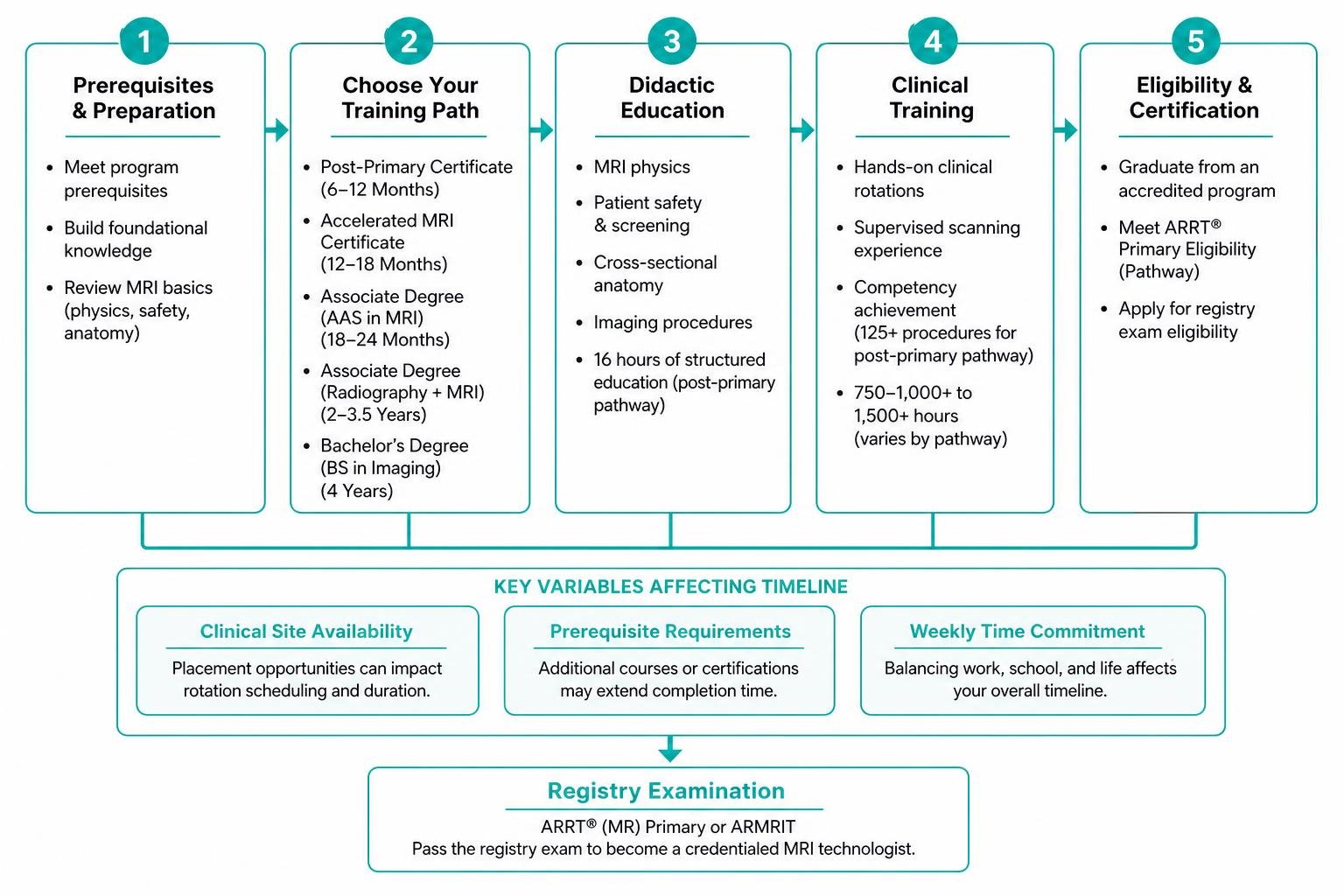
How Long Does It Take to Become an MRI Tech from Scratch?
Starting from scratch with zero medical background takes 14 to 24 months on average. If you are wondering, Is MRI Tech School Hard? What to Expect on Your Journey, the main challenge is mastering cross-sectional anatomy and magnet safety protocols rather than basic memorization.
Your timeline when starting fresh generally breaks down into distinct phases:
- Prerequisites and Clearances (1–3 Months): Completing foundational anatomy and physiology, college algebra, medical terminology, background checks, drug screenings, and CPR/BLS certification.
- Didactic Coursework (4–6 Months): Mastering pulse sequences, tissue relaxation times, artifact reduction, contrast administration, and Zone I–IV safety protocols.
- Clinical Rotations (6–12 Months): Spending 16 to 24 hours per week at an imaging facility scanning live patients under direct supervision to log competencies.
How Long Does It Take to Become an MRI Tech While Working Full-Time?
Balancing a 40-hour workweek with MRI school stretches the timeline to 18 to 24 months. While flexible Online MRI Courses allow you to study didactic modules early in the morning or on weekends, hands-on clinical rotations require dedicated daytime or evening scanner hours.
Most working students succeed by:
- Transitioning to 3×12-hour work shifts or weekend coverage at their current job.
- Scheduling two 8-hour or two 10-hour clinical scanning shifts during the week.
- Protecting 10 to 15 hours weekly for self-paced physics and anatomy study.
Attempting to work 40 hours while completing 24 hours of unpaid clinicals often leads to burnout. Planning your finances in advance to temporarily drop to 25–30 work hours per week during the clinical phase is one of the best ways to finish on schedule.
Clinical Rotations and Daily Procedure Caps
Clinical training is where theoretical physics meets real patients, and it represents the largest portion of your training hours. Most programs require between 750 and 1,000+ clinical hours.
For those on the ARRT® post-primary route, the AMERICAN REGISTRY OF RADIOLOGIC TECHNOLOGISTS® enforces clear regulatory rules:
- Daily Procedure Cap: Candidates can log a maximum of 7 clinical experience entries per day to encourage spaced repetition and deep learning over rushing.
- 24-Month Window: All logged clinical competencies must be completed within the 24 months immediately preceding exam application submission.
- In-Person Requirement: All scans must be performed physically on-site; remote or virtual scanning simulations do not count toward mandatory ARRT® clinical logs.
Carefully tracking your procedural sign-offs and maintaining digital backup copies prevents documentation disputes from delaying your exam eligibility.
Credentialing, Examination, and Licensure: The Final Stretch
Completing your didactic and clinical requirements earns your program diploma, but you cannot independently scan patients until you pass your credentialing board exam and secure state authorization.
To qualify for national board testing, you must document competency across core anatomical categories:
- Head and Neck: Routine brain, internal auditory canals, orbits, pituitary gland, and neck soft tissue.
- Spine: Cervical, thoracic, and lumbar spine protocols for disc pathology and trauma.
- Musculoskeletal (MSK): Upper and lower extremity joints including shoulders, knees, wrists, hips, and ankles.
- Body and Abdomen: Liver, MRCP (biliary system), kidneys, female pelvis, and prostate.
- Vascular (MRA/MRV): Time-of-flight and contrast-enhanced angiograms of the circle of Willis, carotids, and renal vasculature.
ARRT® vs. ARMRIT Registry Exam Timelines
The two primary credentialing bodies in the United States are the AMERICAN REGISTRY OF RADIOLOGIC TECHNOLOGISTS® (ARRT®) and the American Registry of Magnetic Resonance Imaging Technologists (ARMRIT).
- The ARRT® (MR) Exam: Consists of 220 computer-based questions (200 scored, 20 unscored pilot questions) with a 3.5-hour time limit. It evaluates image production (30%), clinical procedures (27%), patient care (26%), and safety (17%). A scaled score of 75 is required to pass.
- The ARMRIT Exam: Consists of 225 multiple-choice questions focusing on MRI physics, safety, clinical applications, and anatomy, also requiring a 75 passing score.
Scheduling your examination through a testing center typically takes 2 to 4 weeks after your educational credentials and clinical competencies are verified. Dedicating 8 to 12 weeks to an ARRT® MRI Registry Review: How to Pass on Your First Try ensures you retain vital pulse sequence mechanics and pass on your first attempt.
State Licensure and First Paycheck Timeline
After passing your board exam, state licensing takes anywhere from 2 to 12 weeks depending on your state’s health department workload. Approximately 75% of U.S. states mandate an individual state license or registration to operate diagnostic imaging equipment.
Given the ongoing national shortage of imaging technologists, with over 85% of healthcare facilities reporting recruitment challenges, many students receive conditional job offers during their final clinical rotation. For a deeper look at compensation and regional demand, explore The MRI Tech Job Outlook and Career Growth in 2026.
Frequently Asked Questions About MRI Technologist Timelines
Can you become an MRI technologist in 6 months?
A 6-month timeline is only possible for existing medical imaging professionals who already hold an ARRT® credential in radiography, sonography, or nuclear medicine. These technologists can complete structured education and clinical competencies through an accelerated post-primary pathway. For beginners with no prior imaging experience, completing didactic physics and 750+ clinical hours in 6 months is not realistic.
How many clinical hours are required to become an MRI tech?
Most comprehensive primary certificate and associate degree programs require between 750 and 1,000+ supervised clinical hours (roughly 1,500 hours for collegiate programs). For ARRT® post-primary candidates, the requirement is defined by clinical competencies: candidates must document a minimum of 125 clinical procedure repetitions across specified anatomical categories rather than a fixed hour count.
Does prior allied health experience count toward MRI clinical scanner hours?
No. While prior experience as a Patient Care Technician (PCT), Emergency Medical Technician (EMT), Certified Nursing Assistant (CNA), or Medical Assistant (MA) helps with patient transfers, vital signs, and IV placement, it does not count toward mandatory MRI scanner hours. All clinical competencies must involve direct operation of the scanner console and coils under the active supervision of a credentialed ARRT®(MR) or ARMRIT technologist.
Conclusion
Becoming an MRI technologist offers a direct route to a stable, well-compensated career in modern healthcare. Whether you choose a 6-to-12-month post-primary cross-training pathway or an 18-to-24-month direct-entry associate degree, staying consistent with your clinical shifts and exam preparation is the surest way to finish on schedule.
Once you earn your credentials, maintaining your license requires completing 24 Category A continuing education credits every two years under ARRT® guidelines. At Scrubs CE, we provide affordable, self-paced courses with instant certificates to make maintaining your credentials simple and stress-free.
Ready to map out your entire imaging journey from enrollment to clinical mastery? Explore The Ultimate Guide to Becoming an MRI Tech and Attracting Success to take your next career step with confidence.