

What Is MRI Tech School and Is It Really Hard?
When students ask if mri tech school is hard, the answer usually comes down to two specific subjects: MRI physics and cross-sectional anatomy. Unlike general X-ray imaging, which relies on ionizing radiation to produce flat, two-dimensional projection images, magnetic resonance imaging relies on complex nuclear magnetic resonance principles, strong magnetic fields, and radiofrequency pulses to build multi-planar cross-sectional views.
To master this field, you must learn MRI Training 101 basics: how hydrogen protons in human tissue align inside a powerful magnetic field, how gradient magnetic fields spatially encode signals, and how pulse sequencing parameters (like TR, TE, and flip angles) affect image contrast and resolution. Developing strong spatial reasoning is essential because you will evaluate internal anatomy across axial, sagittal, and coronal planes.
Beyond the classroom math and physics, patient safety adds serious practical responsibility. MRI suites contain constantly active high-field magnets (typically 1.5 Tesla to 3.0 Tesla or higher) that create intense magnetic force, making strict safety screening an absolute daily priority.
Physical and Technical Demands of MRI Technology
The day-to-day physical demands of an MRI technologist are continuous throughout every shift:
- Patient positioning and mobility support: Technologists frequently assist injured, elderly, or bedridden patients onto the scanner table, requiring proper body mechanics and lifting standards (often lifting or supporting up to 50 lbs).
- Physical endurance: You will be on your feet standing and walking up to 80% of your working hours.
- Ferromagnetic screening and safety: High-field magnets attract ferromagnetic materials with dangerous force. Technologists must carefully screen every patient and staff member for metallic implants, pacemakers, insulin pumps, or foreign bodies.
- Managing patient distress: Working with anxious or claustrophobic patients inside a narrow bore scanner requires high empathetic communication skills.
Primary Pathway vs. Post-Primary Pathway MRI Tech School Options
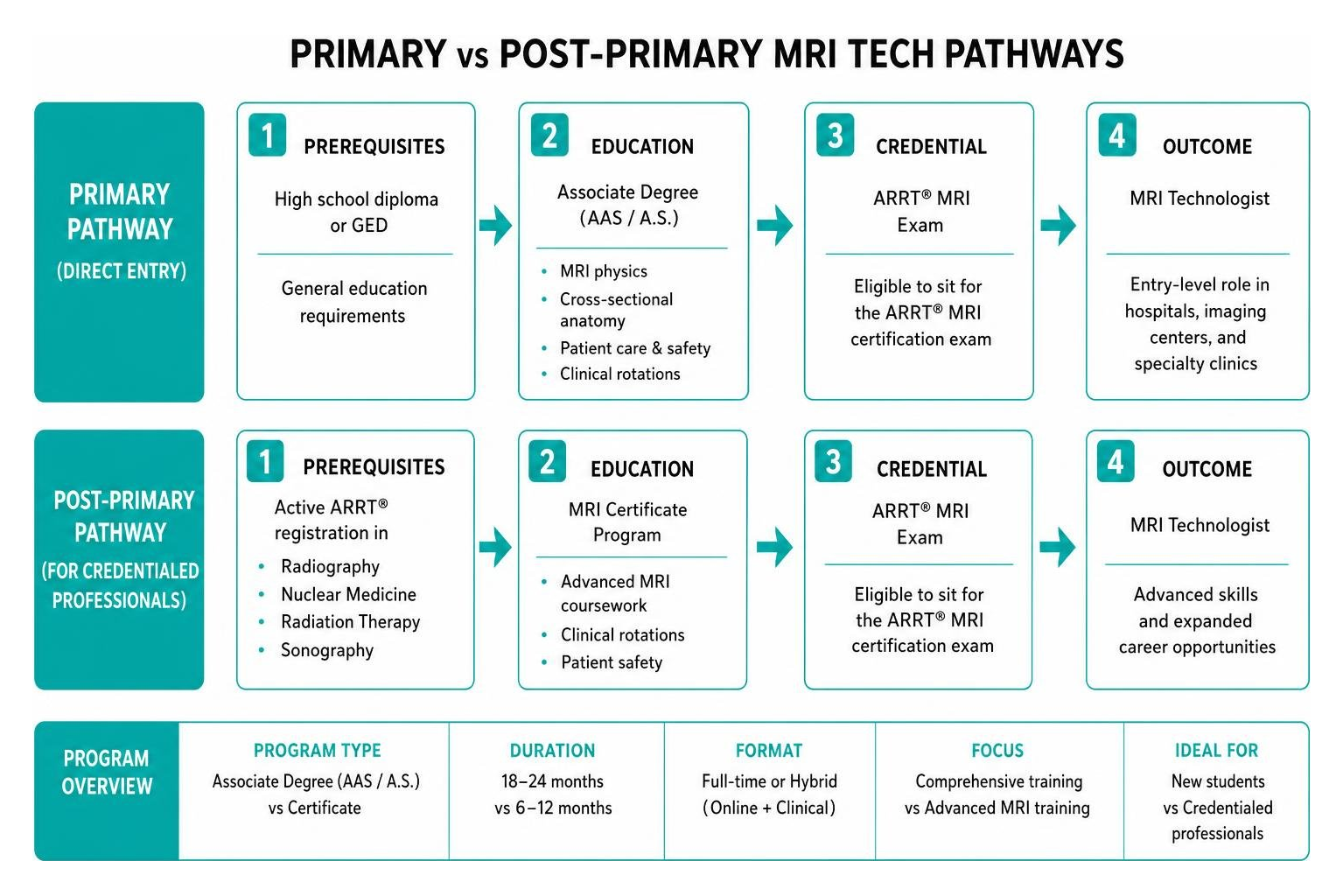
Historically, becoming an MRI tech required earning an associate degree in general Radiologic Technology first. Today, prospective students have two distinct educational avenues recognized by the AMERICAN REGISTRY OF RADIOLOGIC TECHNOLOGISTS® (ARRT®):
- ARRT® Primary Pathway (Direct Entry): Designed for students without prior Radiology credentials. These full-time programs combine general education, specialized MRI physics, cross-sectional anatomy, and clinical rotations into an Associate of Applied Science (AAS) or Associate of Science (A.S.) degree.
- ARRT® Post-Primary Pathway: Designed for healthcare professionals who already hold active registration in Radiography (X-ray), Nuclear Medicine, Radiation Therapy, or Sonography. These certificate programs focus strictly on advanced MRI coursework and clinical hours, often taking 6 to 9 months to complete.
If you are exploring local options, reviewing specialized CT and MRI Certificate Programs or post-graduate options like the Magnetic Resonance Imaging (MRI) Program | Greenville Technical College can clarify how post-primary options fit working technologists.
Types of Programs, Prerequisites, and Completion Timelines
Finding the right mri tech school depends on your background, schedule, and learning style. Educational institutions offer three main program structures:
- Associate Degree Programs (AAS / A.S.): Usually take 18 to 24 months (6 quarters or 6 modules) and provide a direct entry primary pathway for beginners.
- Certificate Programs: Take 6 to 12 months, catering primarily to credentialed Radiologic Technologists.
- Hybrid Programs: Combine online didactic lectures (physics, anatomy, ethics) with local hands-on labs and arranged clinical externships.
| Program Type | Target Student | Typical Length | Average Clinical Hours | Primary Credential Goal |
|---|---|---|---|---|
| Direct-Entry Associate Degree | Beginners / Career Changers | 18 – 24 Months | 960 – 1,020 Hours | ARRT® or ARMRIT® Certification |
| Post-Primary Certificate | Registered Rad Techs | 6 – 12 Months | 495 – 900 Hours | ARRT® Post-Primary Credential |
| Accelerated Hybrid Certificate | Beginners / Career Changers | 12 – 18 Months | 1,000 Hours | ARMRIT® / ARRT® Credential |
Admissions Requirements and Prerequisites
Admissions processes can be selective due to limited clinical placement slots. To qualify, you generally need:
- A high school diploma or GED equivalent.
- Completion of core college prerequisites (Anatomy and Physiology I & II, College Algebra or Statistics, English Composition, and Communication) with a minimum GPA (often 3.0 in prerequisite subjects).
- Passing scores on allied health entrance exams, such as the Criteria Cognitive Aptitude Test (CCAT).
- Formal background checks, drug screenings, and active CPR / Basic Life Support (BLS) certification.
- Complete immunization records (Hepatitis B series, TB screening, flu shot).
- Documented job shadowing in an active MRI department (recommended or required by many programs).
For a deeper look into baseline allied health standards, read our guide on general Radiologic Technologist Requirements.
Cost Breakdown and Financial Aid for MRI Tech School
The cost of attending mri tech school varies widely depending on the institution type:
- Public Community Colleges: Often range between $3,000 and $16,000 total for in-state tuition and fees.
- Private Vocational Schools and Academies: Can range from $11,500 up to $28,000 depending on location and degree level.
Financial aid options include federal Pell Grants, Direct Subsidized and Unsubsidized Loans for accredited institutions, state grants, flexible institutional payment plans, and healthcare employer tuition reimbursement programs. Programs like the MRI Program | Gurnick Academy Of Medical Arts demonstrate how structured credit hour systems and institutional financial plans operate for full-time students.
What You Learn: MRI Tech Curriculum and Clinical Rotations
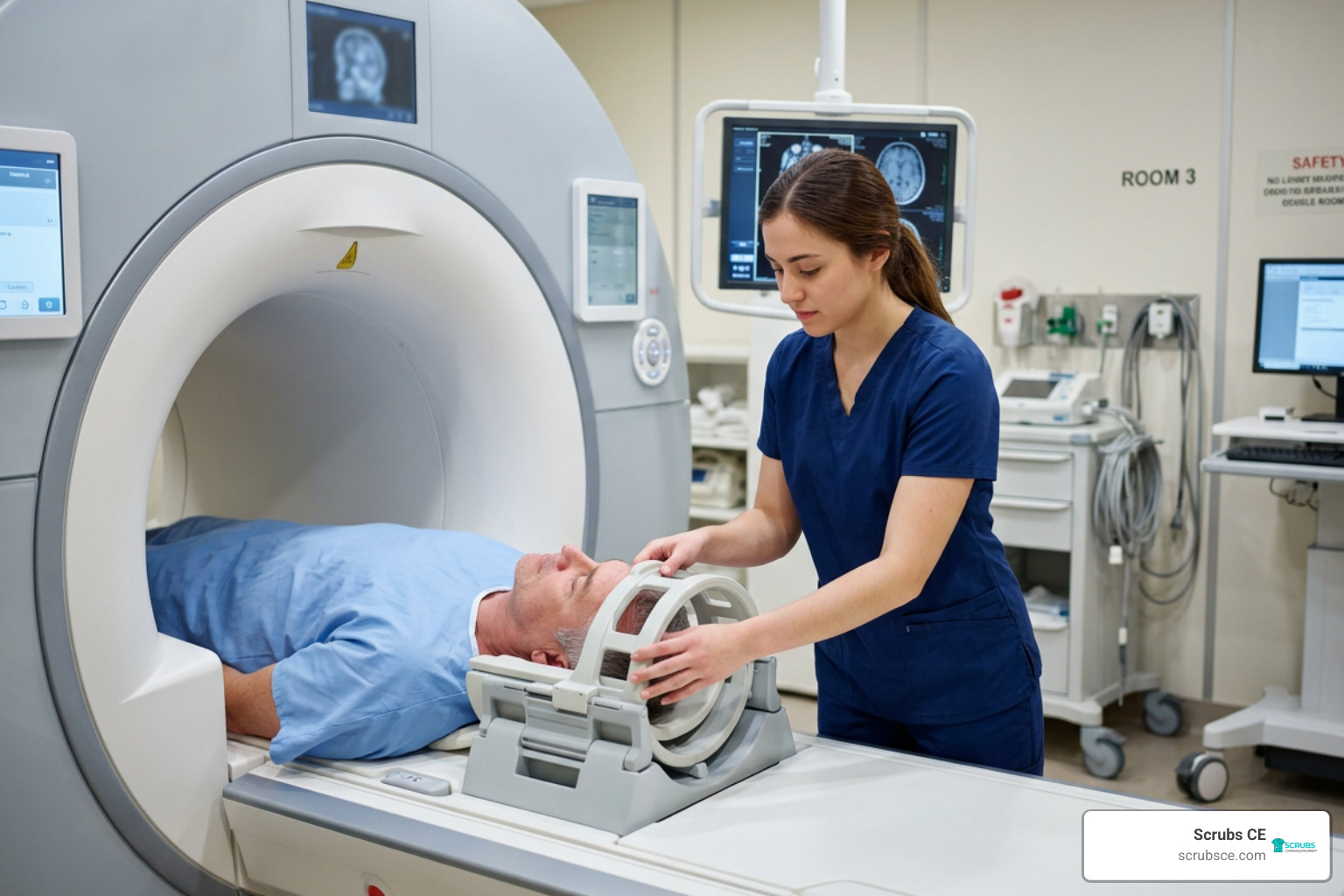
The didactic portion of mri tech school builds technical knowledge from the ground up. Core topics cover:
- MRI Physics and Instrumentation: Electromagnetic principles, radiofrequency pulses, spatial encoding, K-space filling, signal-to-noise ratios (SNR), and pulse sequence optimization.
- Cross-Sectional Anatomy: Brain, spine, musculoskeletal, abdominal, pelvic, and cardiovascular imaging across multiple planes.
- Patient Care and Safety: Contrast agent administration, venipuncture techniques, monitoring vital signs, handling claustrophobia, and implementing safety protocols outlined in our review of Essentials of MRI Safety.
Clinical Training Requirements and Rotations
Classroom theory must be applied in clinical settings under the direct supervision of registered technologists and radiologists.
- Clinical Benchmark Hours: Direct-entry degree programs generally require between 900 and 1,020 clinical hours, whereas post-primary certificates require around 495 hours.
- Virtual Simulation Software: Programs frequently integrate high-fidelity platforms (such as Corsmed MRI simulators) to help students practice parameter adjustments and pulse sequencing on virtual patients before entering live clinical suites.
- Clinical Placement Settings: Rotations are completed in high-volume hospital suites, emergency trauma centers, and outpatient diagnostic imaging centers.
Notable institutions, such as the Magnetic Resonance Imaging (MRI) Program (Minnesota) – Health Sciences Education – Mayo Clinic College of Medicine & Science and accelerated options like the 24-Month MRI Tech Program in Illinois | Aquarius Institute , prioritize intensive clinical immersion on state-of-the-art scanners (ranging from 1.5T to high-field 3.0T or 7.0T systems).
ARRT® vs. ARMRIT® Certification Pathways
Upon graduation, you must pass a national credentialing examination to practice professionally. Two primary organizations credential MRI technologists in the United States:
- AMERICAN REGISTRY OF RADIOLOGIC TECHNOLOGISTS® (ARRT®): The primary national registry recognized by nearly all hospitals and clinical employers across the nation. Candidates must pass a 200-question exam covering patient care, safety, image production, and procedures. Prepare thoroughly using our dedicated guide for MRI Registry Review.
- American Registry of Magnetic Resonance Imaging Technologists (ARMRIT®): An organization focused exclusively on magnetic resonance imaging. ARMRIT® certification is widely recognized in outpatient diagnostic centers and private imaging facilities, offering a dedicated path for direct-entry graduates.
Career Outlook, Salary, and State Licensing Requirements

Graduating from mri tech school prepares you for a solid healthcare career. According to the U.S. Bureau of Labor Statistics (May 2025 BLS data), the national median annual salary for MRI technologists is $95,480. Employment in the field is projected to grow by 6% from 2022 to 2032 (and through 2033), driven by an aging population and higher demand for advanced, non-invasive diagnostic imaging.
Pay scales vary significantly based on geographic location, clinical setting, and shift differentials:
- New York: Average annual salary of approximately $90,000, with a typical range between $72,000 and $115,000 depending on the metro area.
- California and High-Cost States: Median salaries frequently exceed $100,000 annually in major metropolitan health systems.
- Career Settings: Certified techs work in community hospitals, academic medical centers, outpatient imaging networks, mobile MRI units, or high-paying travel assignments. Explore your options in our detailed breakdowns of MRI Tech Jobs and high-paying MRI Tech Jobs Travel.
State-by-State Licensure and ARRT® Compliance
Because MRI uses strong magnetic fields and non-ionizing radio waves rather than X-rays, state licensure rules differ from general Radiography:
- State Health Department Licensing: States like Oregon, West Virginia, and New Mexico explicitly require state-issued licenses for MRI operators.
- Employer Requirements: Even in states where state government licensure is not mandated for non-ionizing imaging, almost all major hospitals and health systems require active national certification through the ARRT® or ARMRIT®.
- Continuing Education: Maintaining your credentials requires completing continuing education (CE) credits biennially. Learn more in our overview of Radiologic Technologist Certification Requirements.
How to Choose the Best MRI Tech School for Your Career
Choosing the right program determines your board pass rates, clinical comfort, and job placement options. Keep these core criteria in mind:
- Institutional and Programmatic Accreditation: Verify that the institution holds regional accreditation and programmatic approval through bodies such as the Joint Review Committee on Education in Radiologic Technology (JRCERT) or the Accrediting Bureau of Health Education Schools (ABHES).
- ARRT® and ARMRIT® Qualification: Ensure program completion directly qualifies you to sit for national credentialing examinations.
- Clinical Network and Placement: Check if the school guarantees local clinical rotations or requires you to arrange your own externship site.
- Faculty Ratios and Facilities: Look for standard lecture ratios (e.g., 1:20) and lab or clinical ratios (1:1 or 1:2) that support individualized learning.
Review examples of accredited educational frameworks, such as the MRI Technology – BatesTech – BatesTech primary pathway or the hybrid associate degree at Magnetic Resonance Imaging Training Program | CBD College , to understand program expectations.
Key Questions to Ask Admissions Officers
Before submitting an application fee, ask these direct questions during your interview:
- Is clinical site placement fully arranged and guaranteed by the school within a reasonable commuting distance?
- What are the board exam first-time pass rates for ARRT® and ARMRIT® over the past three years?
- Does the curriculum include hands-on simulation software (like Corsmed) to practice scanning parameters prior to clinicals?
- What is the total out-of-pocket cost, including tuition, lab fees, software, scrubs, and medical clearances?
Frequently Asked Questions about MRI Tech School
Can I become an MRI technologist without prior X-ray or Radiology experience?
Yes. Thanks to the ARRT® Primary Pathway and direct-entry ARMRIT®-accredited programs, career changers can enroll in direct-entry Associate of Applied Science programs without holding a prior radiography degree or X-ray license. Check out our guide on pursuing a Radiologist Technician Career for additional context on imaging pathways.
How long does it take to complete MRI tech school?
Direct-entry associate degree options take 18 to 24 months (around 6 quarters or 6 modules). Post-primary certificate programs for existing Radiologic Technologists take between 6 and 12 months.
What is the hardest part of MRI tech school?
Most students find MRI physics (understanding pulse sequences, flip angles, gradient fields, and K-space) and 3D cross-sectional anatomy to be the most challenging academic hurdles. Managing claustrophobic patients under tight clinical schedules is the primary practical challenge.
Conclusion
Succeeding in mri tech school takes hard work, consistent study habits, and hands-on dedication, but it leads directly to a rewarding career in modern diagnostic healthcare. By understanding the curriculum, clinical commitments, and certification pathways ahead of time, you can confidently take the first steps toward your career.
At Scrubs CE, we are here to support your professional journey every step of the way. From your initial training through years of clinical practice, maintaining your professional credentials requires reliable, high-quality continuing education. When you are ready to complete your required biennial credits or expand your knowledge base, explore how you can advance your imaging career with flexible MRI CE credits designed to fit your busy schedule.