
Requirements to Become an X-Ray Technician: Education, Certification, and Licensure
Requirements to Become an X-Ray Technician: The Short Answer
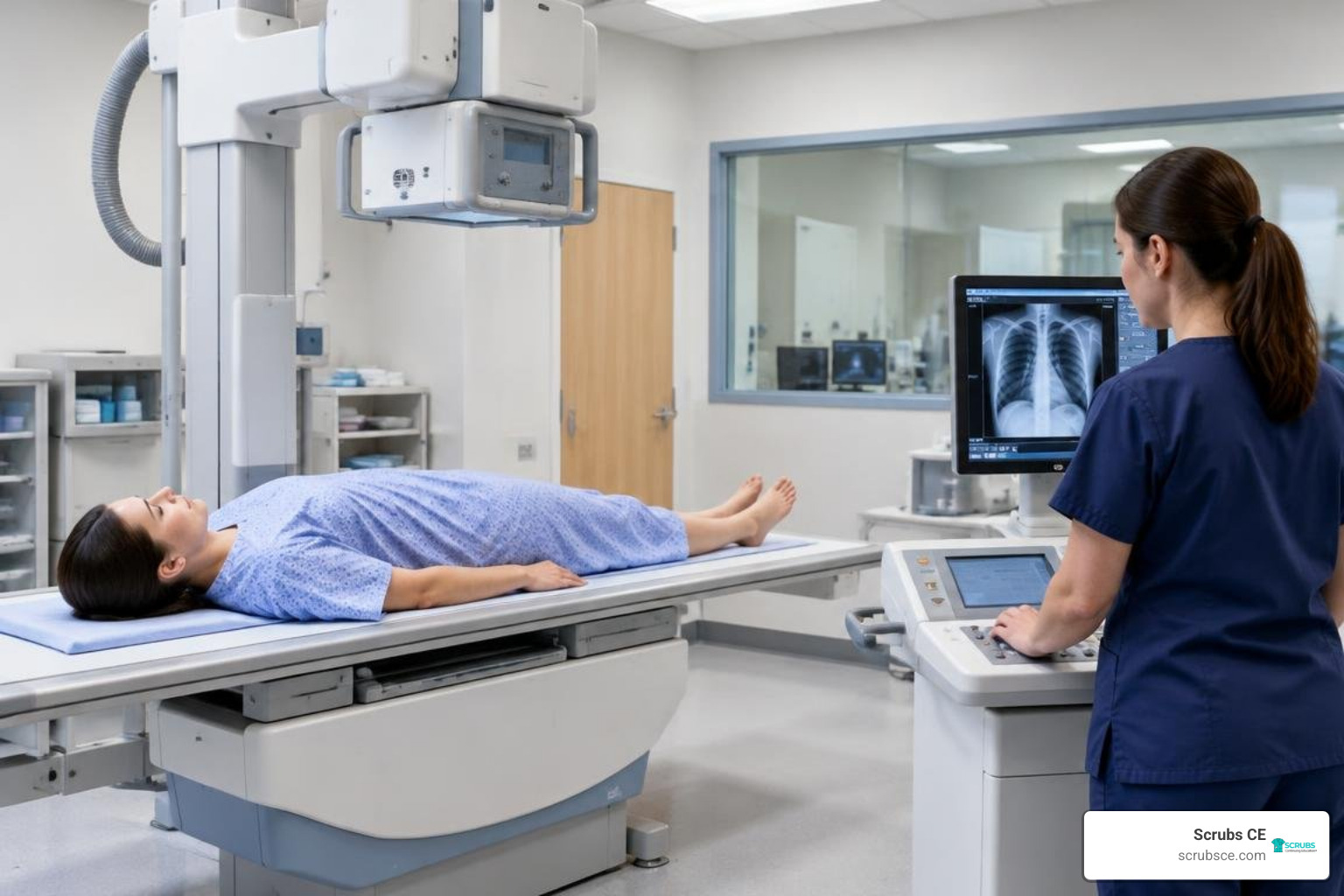
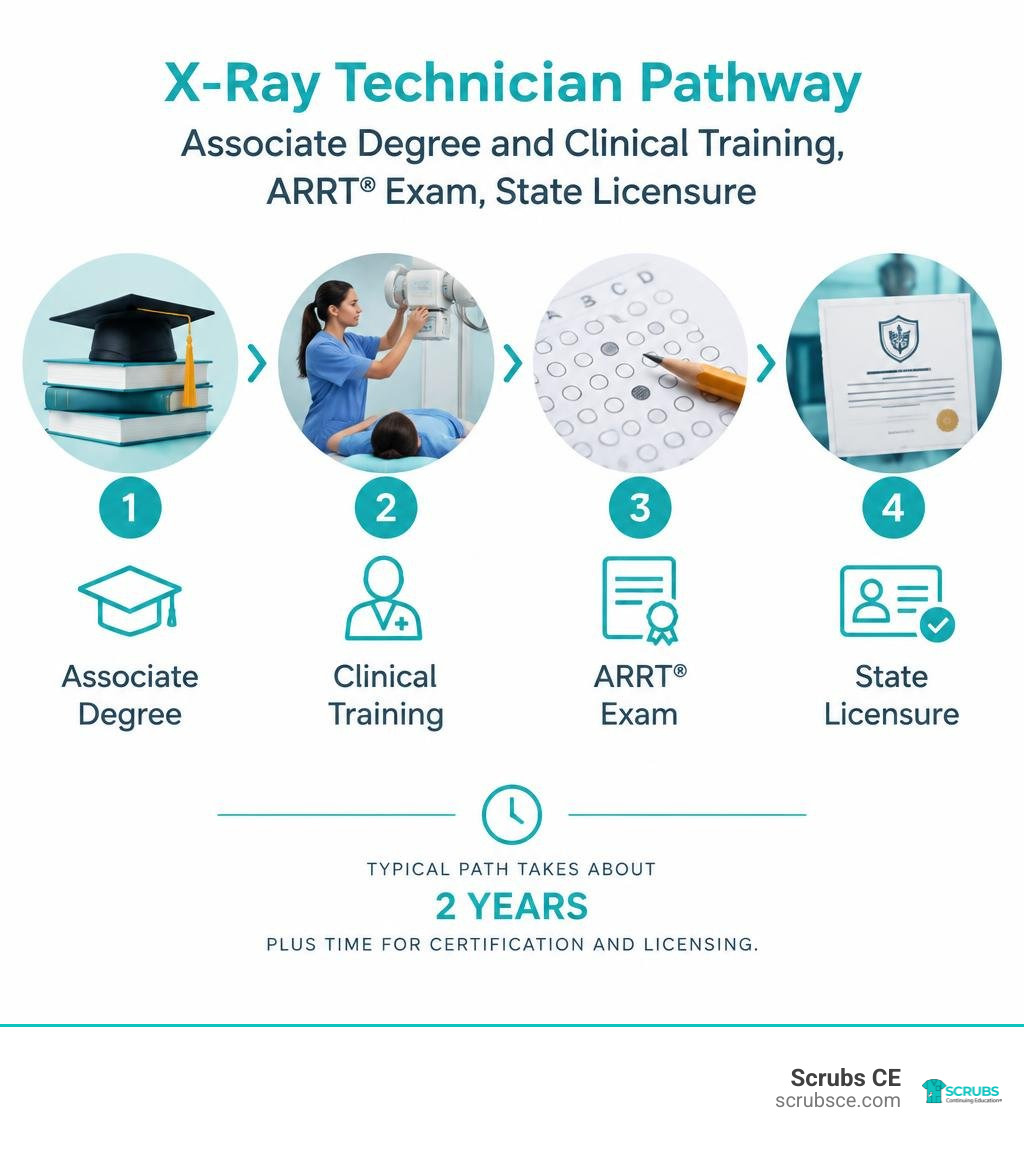
For most U.S. radiography jobs, the requirements to become an x ray technician are to earn an associate degree, complete a radiography program with supervised clinical training, pass the ARRT® radiography exam, and get a state license if required. The usual path takes about two years, plus time for certification and licensing. Some states also offer limited-scope X-ray roles with different training and practice rules.
I’m Zita Ewert, and I lead continuing education for imaging professionals at Scrubs CE. My work with credential and renewal rules informs this guide to the requirements to become an x ray technician.
Requirements to become an x ray technician basics:
- radiologic technologist requirements
- x ray technician job requirements
- how to become radiologist technician
Core Educational Requirements to Become an X Ray Technician
Stepping behind the diagnostic imaging console requires structured academic preparation combined with direct patient care experience. Aspiring imaging professionals must build a solid foundation in human biological sciences, physical principles of radiation, and clinical safety before operating ionizing equipment on patients.

To qualify for national credentialing and state licensure, you must graduate from an educational program accredited by an agency recognized by the AMERICAN REGISTRY OF RADIOLOGIC TECHNOLOGISTS® (ARRT®), such as the Joint Review Committee on Education in Radiologic Technology (JRCERT). These programs ensure that every student masters standard diagnostic protocols, patient protection guidelines, and clinical equipment operations.
High School Preparation and Baseline Requirements to Become an X Ray Technician
Preparing for a career in diagnostic imaging begins well before enrolling in a post-secondary program. High school students and career changers should focus on foundational coursework that simplifies future technical training:
- Biology and Anatomy: Builds fundamental understanding of organ systems and internal structures.
- Physics: Provides insight into electromagnetic radiation, energy waves, and matter interactions.
- Algebra and Geometry: Essential for calculating radiation exposure factors, distance relationships, and angular projections.
- Medical Terminology and English: Establishes critical communication skills needed for charting and interprofessional collaboration.
Candidates must hold a high school diploma or GED equivalent and typically be at least 18 years of age prior to beginning clinical rotations.
Accredited Associate Degree in Radiologic Technology
The primary educational benchmark for fully credentialed radiographers is an associate degree. While the ARRT® requires an associate degree (or higher) to sit for the national certification exam, the degree itself does not strictly have to be in radiologic sciences, provided you also complete an accredited, ARRT®-approved radiography program. Most candidates satisfy both requirements simultaneously by earning an Associate of Applied Science (AAS) or Associate of Science (AS) in Radiologic Technology.
Prospective students can explore our detailed guide on the associate in radiologic technology to evaluate curriculum structures. Most college programs are selective and require prerequisite general education courses in human anatomy, physiology, college algebra, and written composition with a minimum grade of “C” prior to formal admission.
Didactic Curriculum and Clinical Competency Training
A comprehensive radiologic technology program combines classroom learning (didactic education) with extensive hands-on experience in hospital imaging suites and outpatient centers. A standard curriculum typically covers:
- Radiation Physics and Equipment Operation: Understanding X-ray tube construction, circuit design, and beam filtration.
- Radiation Protection and Radiobiology: Applying ALARA (“As Low As Reasonably Achievable”) principles, shielding methods, and dose monitoring to safeguard patients and staff.
- Image Production and Evaluation: Mastering exposure factors (kVp, mA, time), digital receptor physics, spatial resolution, and artifact identification.
- Radiographic Procedures and Patient Care: Positioning anatomy accurately, utilizing contrast agents, handling sterile fields, and mastering radiographic anatomy definitions to capture clear diagnostic images.
In addition to didactic exams, students must demonstrate independent clinical competency across mandatory and elective imaging procedures verified by clinical instructors.
ARRT® Certification and Examination Standards
National certification serves as the professional benchmark for diagnostic radiography in the United States. Achieving registration validates that an imaging professional possesses the requisite knowledge, technical judgment, and ethical grounding to provide safe patient care.

ARRT® Examination and Certification Requirements to Become an X Ray Technician
The AMERICAN REGISTRY OF RADIOLOGIC TECHNOLOGISTS® administers the primary pathway credential in Radiography: the R.T.(R)(ARRT®) designation. Candidates must complete their accredited educational program and submit application materials within the established three-year eligibility window.
Following our step-by-step guide to x-ray tech certification requirements, candidates sit for a comprehensive computerized exam evaluating four main content categories:
- Patient Care (vital signs, transfer techniques, contrast administration, infection control)
- Safety (radiation physics, radiobiology, occupational and patient protection)
- Image Production (exposure parameters, image acquisition, quality control)
- Procedures (head, spine, pelvis, thorax, abdomen, and extremity positioning)
A scaled score of 75 is required to pass and earn national registration.
The AMERICAN REGISTRY OF RADIOLOGIC TECHNOLOGISTS® Ethics and Review
Technical ability must be paired with high ethical standards. The AMERICAN REGISTRY OF RADIOLOGIC TECHNOLOGISTS® enforces strict ethical guidelines that every candidate and registered technologist must uphold.
During the application process, candidates must disclose all criminal history, including misdemeanors, felonies, military court-martials, and administrative disciplinary actions taken by licensing bodies. Prospective students with prior legal infractions can complete an ARRT® Pre-Application Ethics Review prior to enrolling in school to determine their eligibility for future certification.
Continuing Education and ARRT® Credential Maintenance
Maintaining your national registration requires continuous professional development. To remain in active standing, technologists must:
- Renew their registration annually.
- Earn 24 approved continuing education (CE) credits every two years (biennium).
- Follow ARRT® CE renewal timelines and guidelines established by credentialing bodies like the ARRT® and ASRT® (American Society of Radiologic Technologists).
- Complete Continuing Qualifications Requirements (CQR) every 10 years to evaluate knowledge gaps and targeted learning objectives.
State Licensing, Scope of Practice, and Role Distinctions
While national certification demonstrates professional competence, state law dictates your legal scope of practice. State requirements vary considerably across the United States.
State Licensure Rules and Limited Scope Permits
The majority of states require full licensure to operate diagnostic X-ray machinery. In these jurisdictions, passing the ARRT® national exam satisfies the primary examination requirement for state credentials.
For professionals entering the field via an abbreviated training path, many states issue limited scope permits. For instance, candidates in California apply via the California CDPH Limited Permit Application to perform radiography restricted to specific anatomic areas (such as chest, extremities, or torso-skeletal regions). Similarly, healthcare workers can pursue a Florida basic x-ray license to perform routine exams in clinic settings without completing a full two-year technologist program. Limited scope operators are strictly restricted from performing complex, fluoroscopic, or contrast-enhanced examinations.
Role Comparison: X-Ray Technician vs. Radiologic Technologist vs. MRI Technologist
Understanding title distinctions helps clarify career paths, educational investments, and earning potential. While colloquially grouped together, these roles have distinct scopes of practice. Learn more about the requirements to be a radiologic technologist to determine which path fits your goals.
| Role Feature | Limited Scope X-Ray Technician | Radiologic Technologist (Rad Tech) | MRI Technologist |
|---|---|---|---|
| Typical Education | Diploma / Certificate (3 to 12 months) | Associate Degree (2 years) | Associate / Bachelor’s + Modality Training |
| Primary Credential | State Limited Scope Permit / ARRT® (Limited) | R.T.(R)(ARRT®) | R.T.(MR)(ARRT®) or ARMRIT |
| Scope of Practice | Basic diagnostic X-rays of specific anatomical areas (e.g., chest, extremities) | Full-body diagnostic radiography, fluoroscopy, surgical and trauma imaging | Non-ionizing cross-sectional magnetic resonance imaging of soft tissues, brain, musculoskeletal systems |
| Common Workplaces | Urgent care, family practice, outpatient clinics | Hospitals, trauma centers, outpatient imaging, surgical suites | Diagnostic imaging centers, regional hospitals, specialized neurological facilities |
| National Median Pay (2025) | ~$45,000 – $55,000 (Varies by state/clinic) | $80,110 per year | $95,480 per year |
Career Outlook, Salaries, and Clinical Work Environments
Diagnostic imaging is an integral pillar of modern healthcare, providing steady career stability, competitive compensation, and diverse work environments.
Job Outlook and Salary Expectations
The economic outlook for imaging professionals remains robust:
- Median Annual Wage: According to May 2025 Bureau of Labor Statistics data, the median annual wage for radiologic technologists was $80,110, with the overall earning spectrum ranging from $64,910 for entry-level positions to over $121,420 for experienced technologists in high-demand regions.
- Projected Growth: Employment of radiologic and MRI technologists is projected to grow 5 percent from 2025 to 2035, creating approximately 15,300 annual job openings across the nation to replace retiring workers and meet rising diagnostic demand.
- Regional Variations: Regional markets demonstrate strong local demand; for example, Maryland projects 7% job growth through 2030, with entry-level salaries starting around $50,000 to $55,000 and advanced hospital roles exceeding $70,000 to $85,000.
- Industry Variations: Outpatient care centers often offer higher average compensation ($84,720) compared to individual physician offices ($74,540), though general medical and surgical hospitals employ the largest volume of technologists.
Healthcare Work Settings and Modality Specializations
Fully certified radiologic technologists work in diverse environments, ranging from trauma hospitals to specialized orthopedic clinics. Technologists can explore institutional career networks such as Emory Healthcare Imaging Careers to view active openings across metropolitan health networks.
Once you obtain your primary credential in radiography, you can expand your scope by pursuing post-primary certifications. You can explore medical imaging degrees and modality specialties across multiple high-demand disciplines:
- Computed Tomography (CT): Acquiring 3D cross-sectional images for trauma, vascular, and oncological evaluation.
- Magnetic Resonance Imaging (MRI): Utilizing radio waves and magnetic fields for soft tissue, spine, and brain imaging (median pay: $95,480).
- Mammography: Performing specialized low-dose breast imaging for preventive screening and diagnostic workups.
- Interventional Radiology (IR) & Cardiac Catheterization: Assisting physicians with fluoroscopically guided vascular surgeries, stent placements, and angioplasties.
- Bone Densitometry (DEXA): Measuring bone mineral density to evaluate osteoporosis risks.
Frequently Asked Questions About Becoming an X-Ray Technician
How long does it take to become an X-ray technician?
Completing the path to become a fully certified radiologic technologist typically takes 2 years through an accredited associate degree program. Some students choose 4-year bachelor’s degree programs for expanded leadership pathways. Limited scope X-ray technician programs take between 3 to 12 months (such as 120-hour state-specific clinic training programs), after which candidates sit for state-level limited exams.
Can you become an X-ray tech without a degree?
To become a fully certified radiologic technologist registered with the ARRT®, you must hold at least an associate degree. However, you can become a limited scope X-ray technician in certain states without an associate degree by completing an approved state certificate program and obtaining a limited practice permit for designated clinic settings.
What essential skills ensure success as an X-ray technician?
Success in diagnostic imaging relies on a blend of technical capability and interpersonal aptitude:
- Technical Precision: Operating sophisticated digital machinery, setting accurate exposure factors, and positioning patients correctly.
- Radiation Safety Focus: Strict adherence to shielding, collimation, and exposure protocols to protect patients and oneself.
- Physical Stamina: Lifting and transferring non-ambulatory patients, maneuvering heavy portable imaging units, and standing for extended shifts.
- Empathetic Communication: Calming anxious, injured, or pediatric patients to achieve optimal positioning and diagnostic cooperation.
- Attention to Detail: Recognizing image artifacts, verifying physician orders, and reviewing anatomical landmarks before sending studies to the radiologist.
Conclusion
Becoming an X-ray technician or registered radiologic technologist offers a direct, rewarding entry into modern healthcare. By completing an accredited educational program, mastering didactic and clinical competencies, passing your ARRT® exam, and securing your state license, you position yourself for a stable career with expansive advancement options into CT, MRI, and beyond.
Maintaining your professional credentials requires continuous learning throughout your career. At Scrubs CE, we provide affordable, self-paced, and state-approved continuing education courses with instant certification certificates to help you fulfill your biennial CE requirements and keep your license active. Explore our complete catalog of Radiology courses to support your career growth and stay current with the latest imaging technologies.