
Find the Right MRI Technologist Training Program

The best MRI technologist training program depends on where you are starting. New students can choose a primary-pathway MRI program, often an associate degree or hospital-based certificate. Already credentialed Radiology professionals can usually take a shorter post-primary program to qualify for the MRI credential through ARRT®. Career changers may also find hybrid programs that lead to ARMRIT certification, though employers and state rules may prefer or require ARRT®.
When comparing MRI technologist training programs, check these four points first:
- Credential eligibility: Does the program prepare you for ARRT® or ARMRIT certification?
- Clinical training: How many supervised clinical hours are included, and does the school secure the site?
- Format and length: Options range from accelerated six-month tracks to two-year associate degrees, with online, hybrid, and in-person formats.
- Local job rules: State licensing and employer requirements can affect which credential will help you get hired.
MRI is a hands-on career. Programs teach MRI physics, anatomy, patient care, image quality, contrast safety, and strict screening for metal and implants. The programs in this comparison range from hospital-based training with extensive clinical experience to flexible college certificates designed for working technologists.
I am Zita Ewert, a continuing-education leader for imaging professionals and the force behind SCRUBS Continuing Education®. My work supporting ARRT®, ARMRIT®, and other imaging CE needs helps professionals evaluate mri technologist training programs and plan for certification, licensure, and long-term career growth.
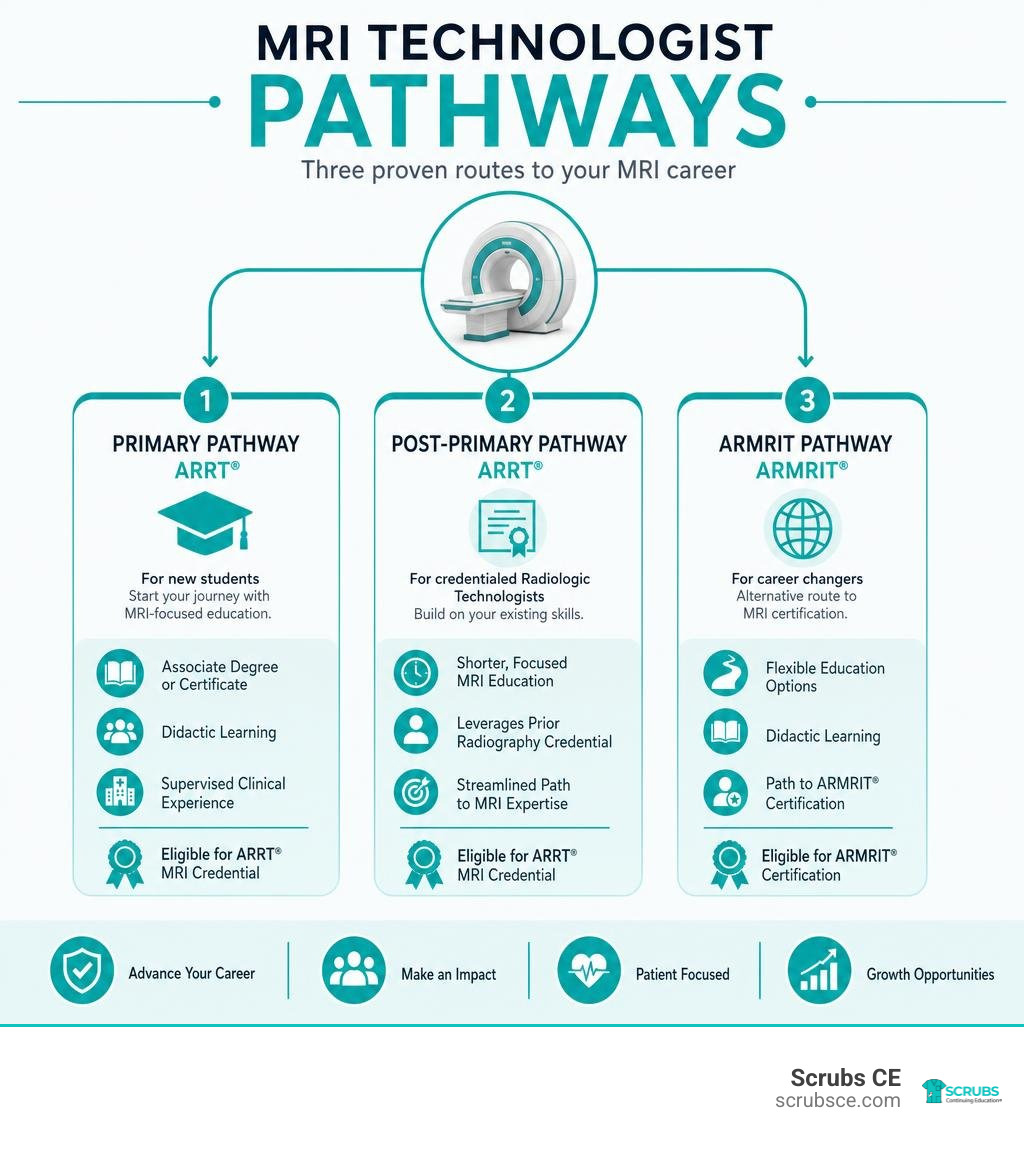
Basic mri technologist training programs terms:
Educational Pathways and Certification for MRI Technologists
Entering the field of magnetic resonance imaging requires navigating structured educational and clinical requirements. Choosing the correct route depends heavily on your prior medical background and career goals.
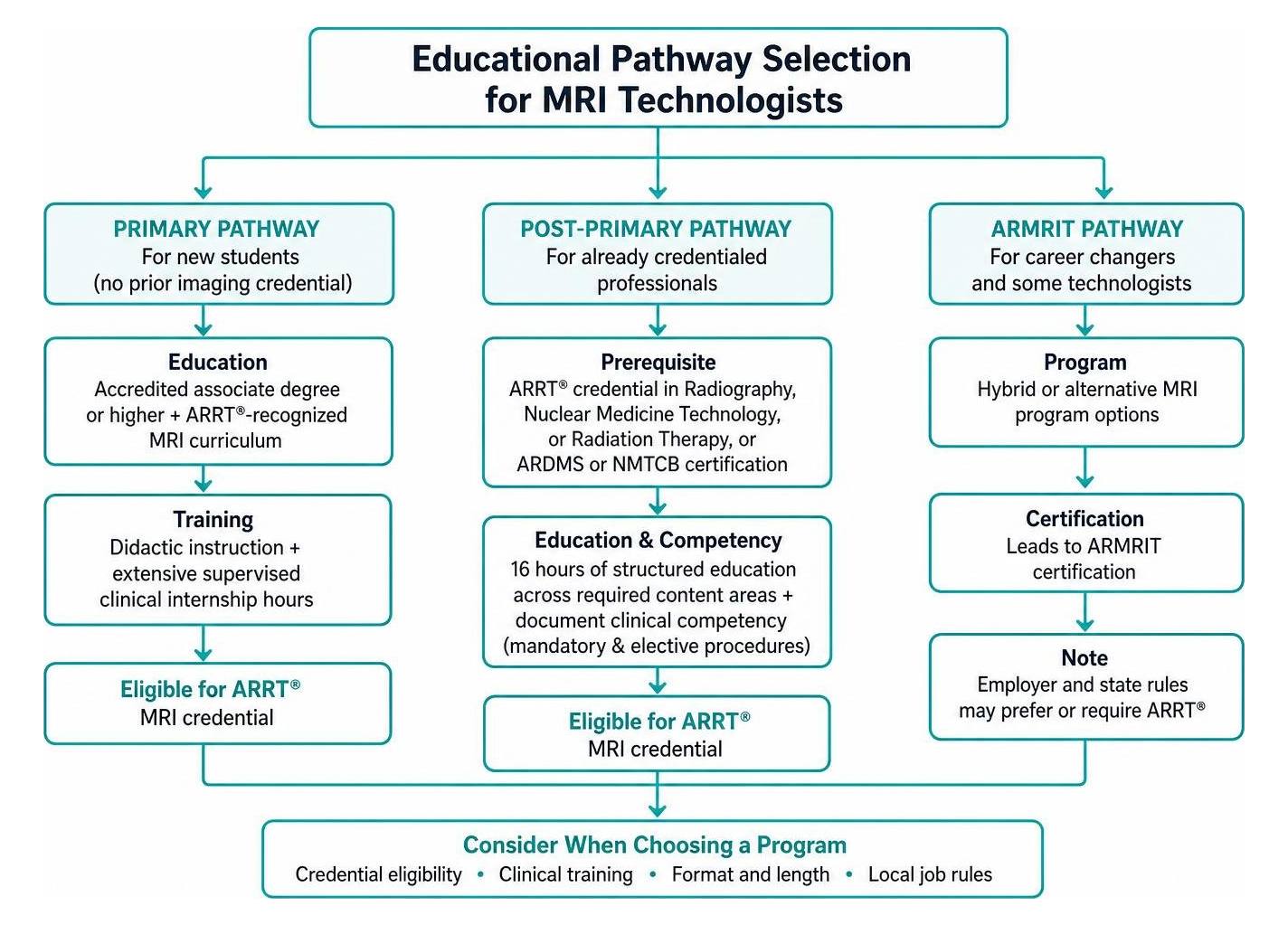
The ARRT® Primary Pathway
Introduced in 2006, the primary eligibility pathway from the AMERICAN REGISTRY OF RADIOLOGIC TECHNOLOGISTS® allows individuals without prior imaging credentials to enter MRI directly. Candidates must complete an accredited academic degree (associate degree or higher) along with an ARRT®-recognized MRI educational curriculum. This track integrates rigorous didactic instruction in cross-sectional anatomy, pulse sequences, patient care, and MRI physics with extensive supervised clinical internship hours.
The ARRT® Post-Primary Pathway
The post-primary eligibility pathway serves healthcare professionals who already hold an ARRT® credential in Radiography, Nuclear Medicine Technology, or Radiation Therapy, as well as those certified through ARDMS or NMTCB. Radiologic technologists complete 16 hours of structured education across specific content areas and document clinical competency across mandatory and elective MRI procedures. You can read a practical guide to how long it takes to become an mri tech to map out timelines for both pathways.
The ARMRIT Certification Alternative
The American Registry of Magnetic Resonance Imaging Technologists (ARMRIT) offers a specialized certification pathway focused exclusively on MRI physics, safety, and clinical scanning. ARMRIT-accredited programs allow direct entry for students and career changers without prior radiography credentials. While widely recognized, hospital systems and outpatient diagnostic centers frequently express a preference for ARRT® credentials. Verifying local employer preferences before choosing an ARMRIT-only program is critical.
State Licensure and Exam Preparation
Licensing requirements vary substantially across state borders. Some states require state-issued licenses mandating national registry credentials, while other states (such as New Jersey) do not require independent state licenses for MRI scanners. Regardless of location, candidates must sit for credentialing exams consisting of 200 multiple-choice questions covering safety parameters, instrumentation, and clinical procedures. For actionable test strategies, see our guide on demystifying the mri tech test and how to ace it.
Comparison of Top MRI Technologist Training Programs
Program formats range from hospital fellowships to collegiate associate degrees. The table below outlines key parameters for leading programs nationwide:
| Institution | Program Type / Credential | Duration | Clinical Hours | Format | Primary Target Audience |
|---|---|---|---|---|---|
| Mayo Clinic | Certificate (JRCERT Accredited) | 12 Months | 900 Hours | In-Person | Direct Entry / Primary Candidates |
| Johns Hopkins Medicine | Post-Primary Fellowship | 12 Months | Full-time Clinical | In-Person / Paid | ARRT® Certified Radiographers |
| University of Utah Health | Certificate of Completion | 6 Months | Extensive System Rotations | In-Person / Clinical | ARRT® Radiographers & Pre-Requisite Holders |
| UNMC | BS / Post-Baccalaureate Certificate | 9 Months | 900+ Hours | Hybrid / Clinical | ARRT® Radiographers (88+ Prior Credits) |
| Bates Technical College | Associate of Applied Science (AAS) | 18 Months (6 Quarters) | Full-time (Q5-Q6) | Hybrid / In-Person | Direct Entry Students |
| Greenville Technical College | Advanced Certificate | 9 Months (2 Semesters) | 495 Hours | Online Didactic / Clinical | ARRT® Registered Radiographers |
| Atlanta Technical College | Technical Certificate (TCC) | 2 Semesters | Integrated Practicum | In-Person / Clinical | ARRT® Credentialed Imaging Professionals |
| College of DuPage | Advanced Certificate | 4 Semesters | Dedicated Affiliates | In-Person / Hospital Sites | ARRT® Certified Radiologic Techs |
Curriculum depth and clinical requirements can feel intense. If you are wondering about the academic workload, explore our breakdown on is mri tech school hard? what to expect on your journey.
Hospital-Based MRI Technologist Training Programs
Hospital-based programs provide immersion within complex clinical environments, exposing students to diverse patient populations and specialized hardware.
Mayo Clinic (Minnesota)
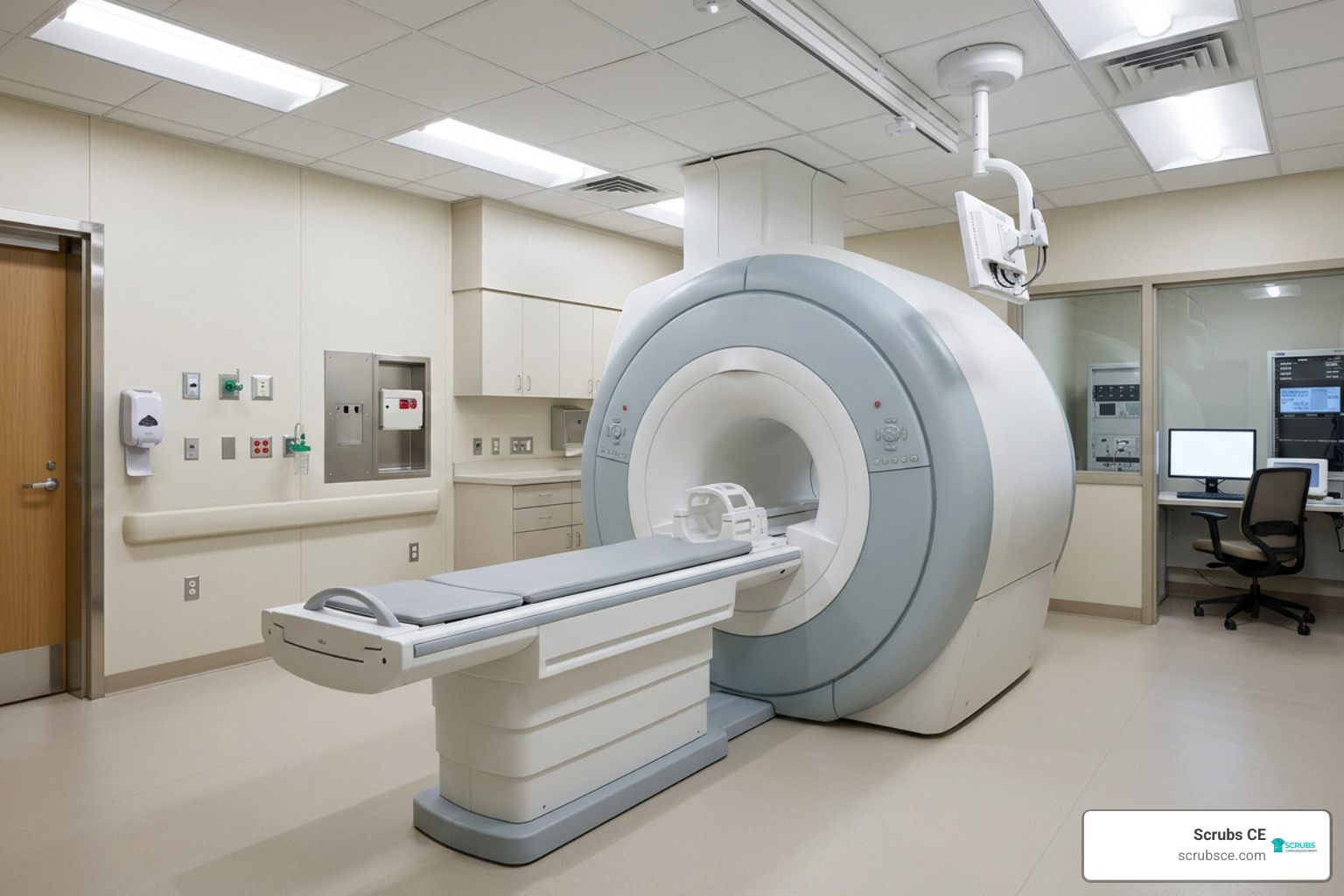
The Magnetic Resonance Imaging (MRI) Program (Minnesota) – Health Sciences Education – Mayo Clinic College of Medicine & Science is a one-year, JRCERT-accredited primary program. Admitting cohorts of up to 16 students per class, the curriculum delivers 900 clinical hours. Students begin patient care interactions after just six weeks and gain rare direct training on scanner field strengths ranging from standard 1.5 Tesla and 3.0 Tesla units up to research-grade 7.0 Tesla systems.
Johns Hopkins Medicine
The Johns Hopkins MRI Technologist Training Program offers an exceptional paid post-primary pathway for ARRT®-credentialed radiographers. The curriculum covers advanced cross-sectional anatomy, physics, protocol optimization, and IV contrast insertion. Clinical training rotates through oncology, pediatrics, trauma, and critical care suites. In exchange for paid tuition and clinical stipends, graduates agree to a two-year employment commitment at a Johns Hopkins Medicine imaging facility. The program maintains a 99% first-time ARRT® advanced certification pass rate.
University of Utah Health
Operating since 2004, the University of Utah School of Medicine offers an accelerated 6-month certificate program. Cohorts are limited to approximately 16 students per session, selected from 35 to 40 applicants. Students rotate through premier facilities, including University Hospital and Huntsman Cancer Hospital, preparing candidates directly for the ARRT® board examination.
College and University MRI Technologist Training Programs
Academic institutions offer flexible didactic structures, ranging from regional technical certificates to full bachelor’s degrees.
University of Nebraska Medical Center (UNMC)
The Magnetic Resonance Imaging < University of Nebraska Medical Center program offers two distinct pathways: a Bachelor of Science in Medical Imaging & Therapeutic Sciences and a Post-Baccalaureate Professional Certificate. Over a nine-month period, students complete more than 900 clinical hours and must document 49 core clinical competencies while training alongside board-certified radiologists and seasoned technologists.
Bates Technical College
Located in Washington State, the MRI Technology – BatesTech – BatesTech Associate of Applied Science degree spans six quarters (18 months) and 95 credits. Designed for direct-entry students, the program delivers hybrid didactic coursework and hands-on laboratory scanning before placing students in full-time clinical rotations (36 to 40 hours weekly) across affiliated regional hospitals.
Greenville Technical College
The Magnetic Resonance Imaging (MRI) Program | Greenville Technical College offers a 9-month, two-semester post-primary certificate for ARRT®-registered radiographers. Didactic instruction is conducted online, allowing working professionals to fulfill the 495 required clinical contact hours (15–18 hours per week) at approved regional medical centers. Explore additional coursework through online mri courses to support your didactic prep.
Atlanta Technical College
The Atlanta Technical College – Magnetic Resonance Imaging Specialist TCC provides a focused, 24-credit-hour certificate across two semesters. At an estimated tuition cost of $4,284, the curriculum prepares credentialed radiographers, nuclear medicine technologists, and radiation therapists for immediate ARRT® registry examination.
College of DuPage
The MRI Program Application packet details an advanced certificate curriculum spread over four semesters. Cohorts are strictly capped at 10 to 15 students per cycle. Acceptance is based on a merit evaluation system combining clinical interviews, academic history, and comprehensive magnetic safety screenings before placing students into clinical affiliate networks like Loyola University Medical Center and Advocate Good Samaritan Hospital.
Career Outlook, Salaries, and Clinical Responsibilities
Magnetic resonance imaging remains one of the most stable and financially rewarding specialties in healthcare. The U.S. Bureau of Labor Statistics (BLS) reports a national median annual wage of $88,180, with overall employment projected to grow 6% through 2033.
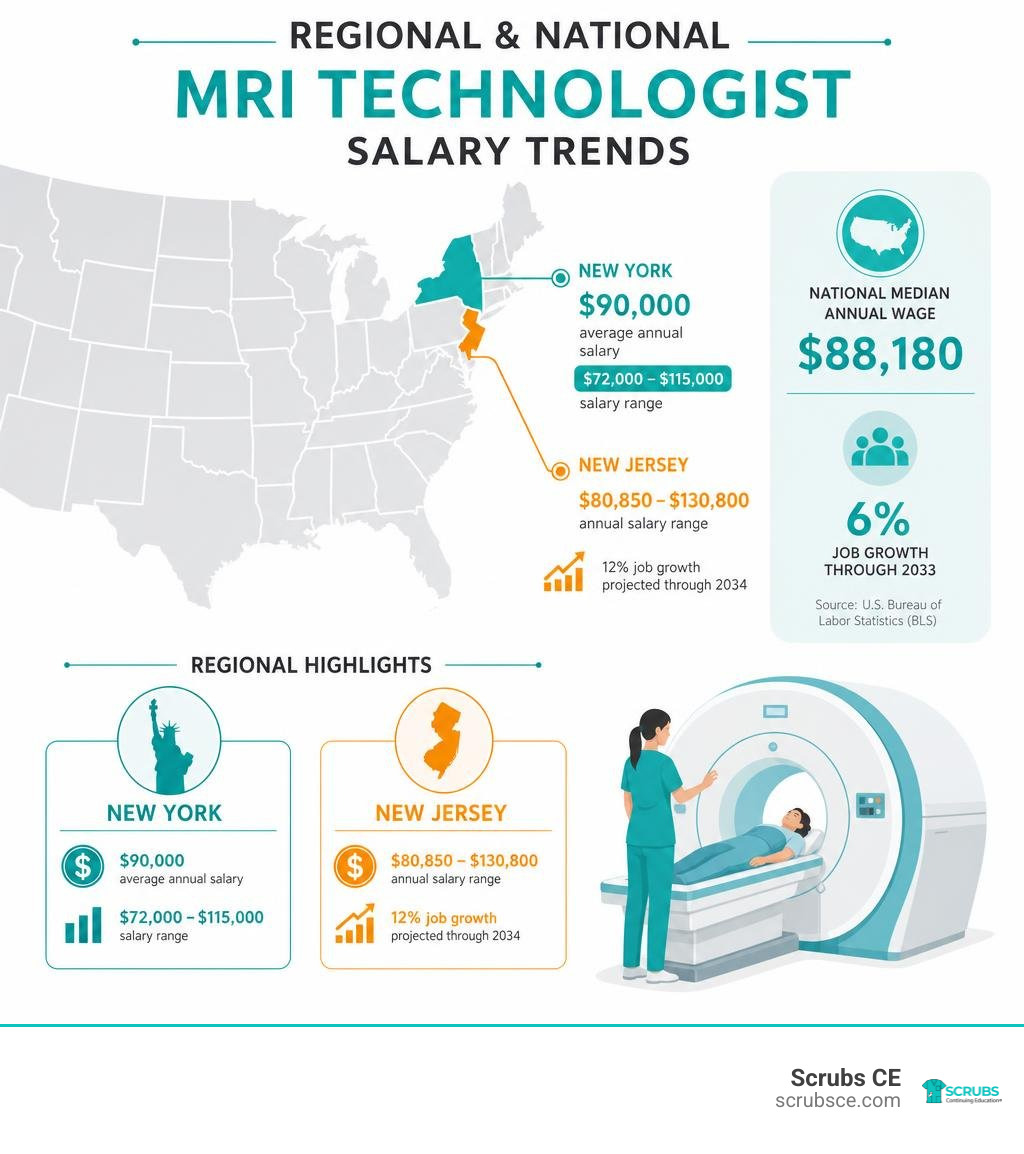
Regional demand drives compensation higher in many metropolitan areas:
- New York: MRI technologists earn an average salary of approximately $90,000 annually, with regional compensation ranging from $72,000 to $115,000 depending on experience and healthcare facility setting.
- New Jersey: Technologists earn between $80,850 and $130,800 annually, supported by a projected 12% job growth rate through 2034.
Core Clinical Responsibilities
MRI technologists operate under rigorous clinical protocols. Daily duties include:
- Safety Screening: Identifying internal ferromagnetic foreign bodies, pacemakers, cochlear implants, and surgical clips.
- Patient Care & Claustrophobia Management: Coaching anxious patients through long sequences in enclosed magnet bores.
- RF Coil Selection & Patient Positioning: Setting up appropriate anatomical surface coils and positioning patients precisely at the magnetic isocenter.
- Parameter Manipulation: Adjusting TR, TE, flip angles, slice thickness, and matrix sizes to maximize signal-to-noise ratio while minimizing artifacts.
- Contrast Media Delivery: Administering gadolinium-based contrast agents via power injectors or manual intravenous lines while monitoring for adverse reactions.
To review complete clinical workflow requirements, consult our comprehensive guide on mri technologist job description and key responsibilities and explore how mobile contracts operate in the ultimate guide to high-paying travel mri tech jobs.
Frequently Asked Questions About MRI Programs
What is the difference between ARRT® and ARMRIT certification?
ARRT® certification is granted by the AMERICAN REGISTRY OF RADIOLOGIC TECHNOLOGISTS® and represents the gold standard credential across major hospital systems, academic trauma centers, and state licensing boards. ARMRIT certification is dedicated solely to magnetic resonance imaging. While widely accepted in specialized imaging centers, some hospital networks require ARRT® registration.
How long does it take to complete an MRI training program?
Program duration depends on your educational background:
- Accelerated Certificate Tracks (6–9 Months): Intended for technologists already certified in Radiography or Sonography.
- Full-Time Hospital Programs (12 Months): Deliver 900+ clinical hours alongside intensive physics coursework.
- Associate Degree Programs (18–24 Months): Cover general education, prerequisites, and up to 1,000 clinical hours for direct-entry students.
Can I become an MRI technologist without prior Radiology experience?
Yes. You can enroll in an ARRT® primary pathway associate degree program or an ARMRIT-accredited training institution. These programs do not require prior radiography licenses, though you will need to complete prerequisite courses in college algebra, human anatomy and physiology, and communication.
Conclusion
Enrolling in an accredited MRI training program is the foundation of a rewarding medical imaging career. Whether you choose an intensive hospital fellowship like Mayo Clinic or a flexible college certificate, mastering magnetic resonance physics and patient care opens doors to long-term career growth.
Once you earn your registry credential, maintaining compliance with biennial continuing education requirements is essential. We invite you to explore continuing education courses for MRI technologists at Scrubs CE, where our self-paced, high-quality courses deliver instant certificates to keep your clinical license active.