
Schooling and Licensing Milestones for Aspiring Radiologic Technologists
Requirements to Become an X-ray Tech: The Short Version

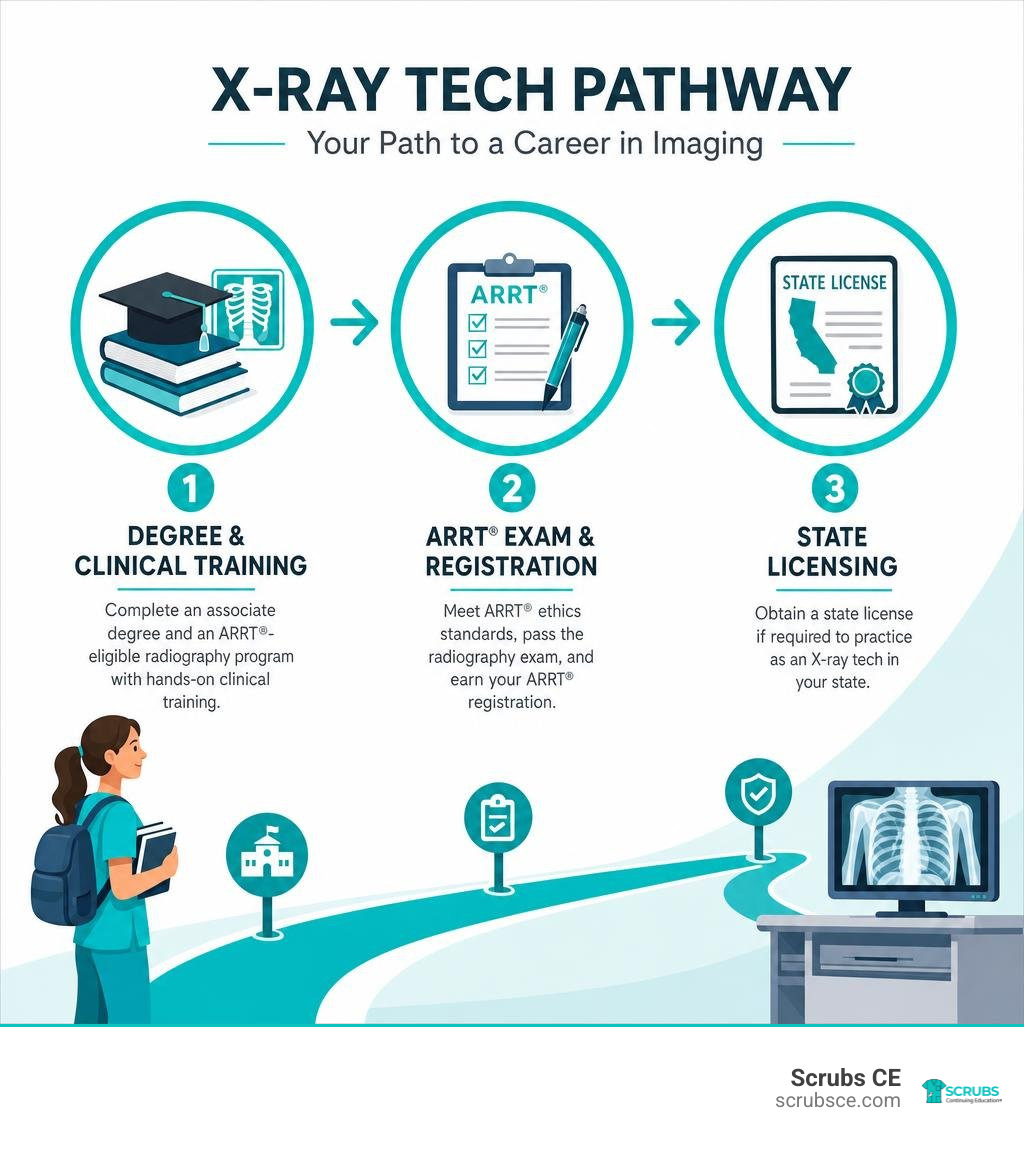
The requirements to become an X-ray tech usually start with an associate degree and a radiography program that meets the eligibility rules of the AMERICAN REGISTRY OF RADIOLOGIC TECHNOLOGISTS® (ARRT®). You will complete hands-on clinical training, meet ARRT® ethics standards, pass its radiography exam, and obtain a state license if your state requires one. The path often takes about two years, though program and licensing timelines vary.
I’m Zita Ewert. Through my work leading continuing education for imaging professionals at Scrubs CE, I help technologists understand how the requirements to become an xray tech lead into the work of keeping credentials current.
Helpful resources on the requirements to become an X-ray tech:
- radiologic technologist certification requirements
- how to become a radiologist technician
- X-ray technician job requirements
Core Education Requirements to Become an X-Ray Tech
Entering the medical imaging field requires a blend of classroom science and intensive, hands-on clinical training. To sit for national credentialing examinations, you must complete an accredited academic program that meets the strict standards set by professional credentialing organizations.

Most healthcare employers require candidates to graduate from an educational program accredited by the Joint Review Committee on Education in Radiologic Technology (JRCERT) or an equivalent institutional accrediting body recognized by the AMERICAN REGISTRY OF RADIOLOGIC TECHNOLOGISTS®. While certificate programs exist, earning an associate degree is the standard entry-level requirement. When planning your path, it is helpful to review the foundational requirements to become an X-ray technician to ensure your chosen school matches your long-term career goals.
As detailed in the Radiologic Technologist Career Overview | Mayo Clinic College of Medicine & Science, academic programs range from two-year associate degrees to four-year bachelor’s degrees. An Associate of Applied Science (AAS) focuses heavily on core radiographic positioning, radiation physics, and immediate clinical skills. In contrast, a Bachelor of Science in Radiologic Sciences (BSRS) incorporates advanced coursework in healthcare administration, research methodology, and multi-modality imaging systems such as CT and MRI.
| Program Metric | Associate of Applied Science (AAS) | Bachelor of Science (BSRS) |
|---|---|---|
| Typical Duration | 20 to 24 continuous months | 4 academic years (or 15–18 month post-associate bridge) |
| Total Credits | 80 to 95 credit hours | 120+ credit hours |
| Curriculum Focus | Radiography, anatomy, physics, clinical rotations | Advanced modalities, leadership, healthcare administration |
| Primary Career Outcome | Entry-level staff radiographer | Staff technologist, clinical instructor, department supervisor |
Academic Prerequisites and Application Standards
Radiography programs are academically rigorous and often have competitive admissions. Before gaining entry into the professional phase of a program, applicants must complete foundational college coursework. Standard prerequisites include:
- Human Anatomy and Physiology (I & II): Comprehensive coverage of the musculoskeletal, cardiovascular, and nervous systems with a laboratory component.
- College Algebra or Physics: Mathematical foundation necessary for mastering radiation dose calculations, inverse square laws, and electrical circuitry.
- Medical Terminology: Learning root words, prefixes, and suffixes required for charting and anatomical positioning.
- Written and Interpersonal Communication: Essential for patient interactions, team collaboration, and accurate clinical documentation.
Many colleges require a minimum cumulative GPA of 2.5 to 3.0 in these prerequisite courses. Admissions committees also frequently require passing scores on standardized health entrance assessments, such as the ATI TEAS examination. For students balancing busy schedules, learning how to start your X-ray tech education from home through hybrid general education coursework provides a flexible way to complete early prerequisites before starting in-person labs.
Clinical Preceptorships and Hands-On Competencies
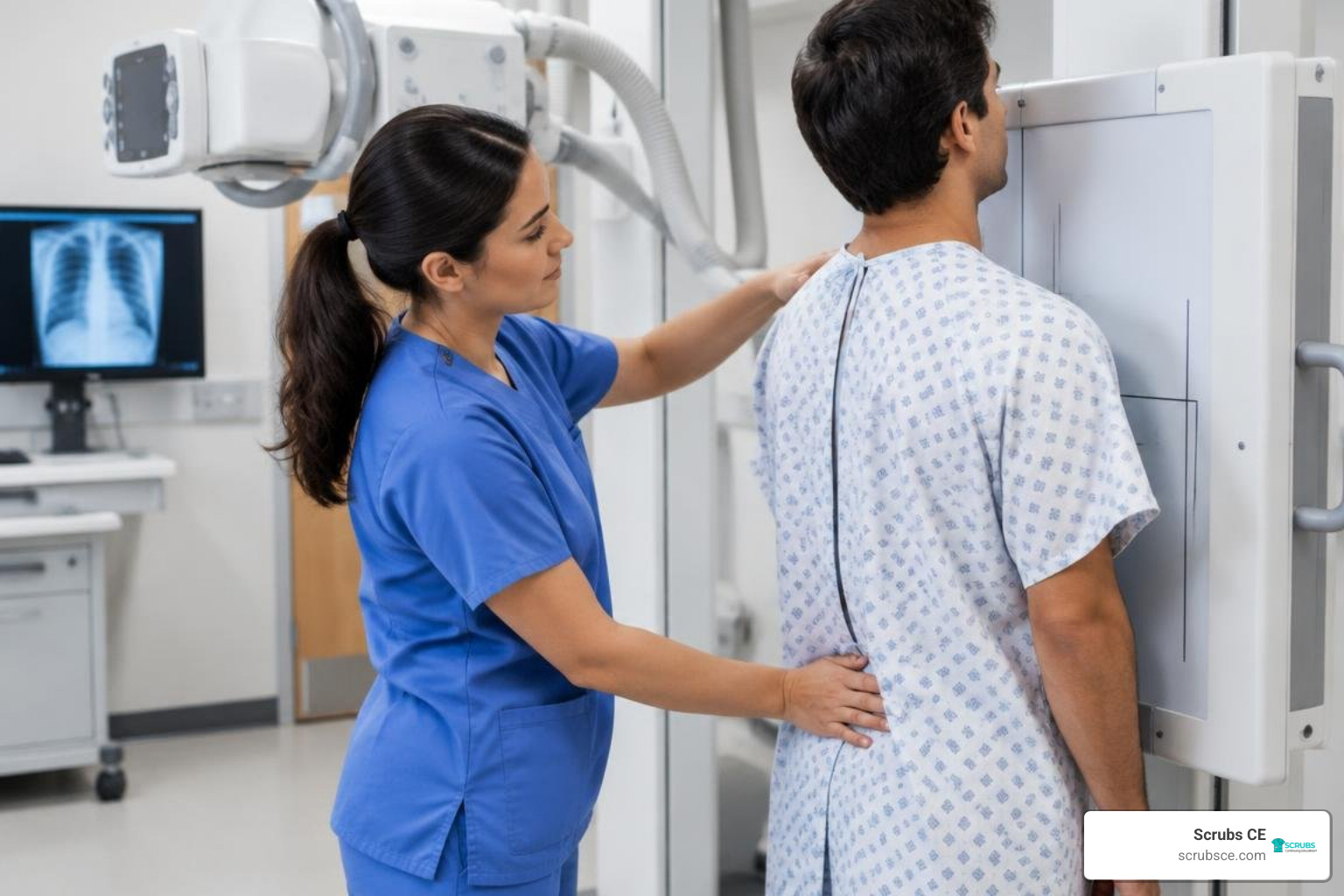
Classroom theory comes to life inside the hospital. Every accredited program integrates structured clinical rotations across inpatient trauma centers, outpatient clinics, urgent care facilities, and surgical suites.
During these rotations, students work alongside experienced registered technologists to master hundreds of patient positioning procedures. Clinical competencies include:
- Chest and Abdominal Imaging: Evaluating lung pathology, line placements, and acute abdominal structures.
- Orthopedic and Trauma Radiography: Positioning extremities and spinal columns safely while accommodating non-ambulatory or injured patients.
- Fluoroscopy and Contrast Media Administration: Assisting radiologists during real-time dynamic imaging of the gastrointestinal and urinary tracts.
- Surgical C-Arm and Mobile Imaging: Maneuvering mobile X-ray units into emergency rooms, intensive care units, and sterile operating rooms.
- Radiation Safety Implementation: Utilizing collimation, lead shielding, and optimal exposure factors to ensure the lowest radiation dose possible.
Professional Certification and State Licensure Pathways
Graduating from an accredited school is a major milestone, but legally practicing as a medical imaging professional requires national certification and, in most jurisdictions, state-specific licensure.
National credentialing is managed by the AMERICAN REGISTRY OF RADIOLOGIC TECHNOLOGISTS® (ARRT®). Earning your credentials validates that you have mastered the clinical and didactic standards necessary to provide safe patient care. You can explore these milestones in our step-by-step guide to X-ray tech certification as well as our comprehensive guide to radiologic technologist certification requirements.
Navigating the ARRT® Primary Pathway Examination
To earn the primary credential in Radiography—designated as R.T.(R)(ARRT)®—candidates must apply through the primary eligibility pathway. This process evaluates three fundamental components:
- Education: Completion of an ARRT®-approved educational program and verification of an associate degree (or higher) from an accredited institution. Under the “three-year rule,” graduates must complete their examination within three years of finishing their educational program.
- Ethics: Review of personal background to verify adherence to professional conduct and patient safety standards.
- Examination: Passing the national computer-based examination.
The ARRT® radiography exam is administered at Pearson VUE testing centers nationwide. It consists of 200 scored questions covering four major content categories:
- Patient Care: Vital signs, emergency response, infection control, and patient communication.
- Safety: Radiation physics, radiobiology, occupational exposure protection, and public dose limits.
- Image Production: Technical factor selection (kVp, mAs), digital image acquisition, and image processing.
- Procedures: Anatomical positioning, central ray alignment, pathology evaluation, and equipment manipulation.
State-Specific Licensing Mandates and Department of Health Regulations
National registration and state licensing are distinct credentials. More than 75% of states have individual licensing laws that govern who can operate ionizing radiation equipment on human patients.
According to occupational data from 29-2034.00 – Radiologic Technologists and Technicians, state health departments set unique application requirements, verification standards, and fees. For example, in California, technologists must submit a formal application to the California Department of Public Health Radiologic Health Branch (CDPH-RHB), provide proof of ARRT® certification, and pay initial licensing fees.
Furthermore, maintaining an active state license requires regular renewals. California, for instance, requires biennial renewal along with the completion of 24 approved continuing education credits to keep your license in good standing.
Career Outlook, Specializations, and Daily Responsibilities
Working in medical imaging offers a dynamic career that balances advanced technology with direct patient care. On any given shift, an imaging technologist reviews physician orders, evaluates clinical history, positions patients precisely, and operates complex diagnostic equipment.
The employment landscape for imaging professionals is exceptionally strong. As reported by the Radiologic and MRI Technologists : Occupational Outlook Handbook: : U.S. Bureau of Labor Statistics, overall employment for radiologic and MRI technologists is projected to grow 5% through 2034. This growth is driven by an aging population requiring diagnostic evaluations for arthritis, fractures, and chronic conditions, generating an estimated 15,300 to 15,400 annual job openings across the country.
To transition smoothly into these roles, candidates follow structured pathways to become a radiographer that build both technical and interpersonal confidence.
Evaluating the Pros and Cons of the Profession
Like any healthcare career, medical imaging comes with unique rewards and demanding challenges.
Pros of Becoming an X-Ray Tech:
- Competitive Compensation: The Bureau of Labor Statistics notes that radiologic technologists earn a median annual wage of $80,110, with top earners in specialized imaging centers making upwards of $121,420.
- Fast Entry into Healthcare: You can complete an accredited associate degree and enter the workforce in roughly two years.
- Diverse Work Settings: Technologists work in hospitals, orthopedic clinics, urgent care centers, ambulatory surgical facilities, and mobile imaging units.
- Predictable and Flexible Schedules: Shift options include traditional day shifts, evening trauma coverage, weekend rotations, or on-call emergency hours.
Cons of Becoming an X-Ray Tech:
- Physical Stamina Demands: The job involves standing for long hours, transporting heavy equipment, and physically transferring injured patients onto examination tables.
- Radiation Environment: Working daily with ionizing radiation requires strict adherence to safety protocols and the consistent use of heavy lead aprons.
- Exposure to Pathogens: Technologists frequently encounter bodily fluids, open wounds, and infectious illnesses in emergency and trauma settings.
Post-Primary Modality Specializations and Career Advancement
A major benefit of becoming a registered radiographer is the opportunity for career mobility. After mastering basic diagnostic X-ray, technologists can earn post-primary credentials through the AMERICAN REGISTRY OF RADIOLOGIC TECHNOLOGISTS®. Understanding the requirements to be a radiologic technologist across advanced modalities allows you to expand your scope of practice into:
- Computed Tomography (CT): Performing detailed cross-sectional imaging for acute trauma, stroke evaluation, and oncology staging.
- Magnetic Resonance Imaging (MRI): Utilizing strong magnetic fields and radiofrequency pulses to image soft tissues, neurological structures, and joints (with median wages reaching $95,480).
- Mammography: Specializing in diagnostic and screening breast examinations.
- Vascular and Cardiac Interventional Radiography: Operating fluoroscopy equipment in sterile catheterization suites to assist with vascular stenting and angioplasty.
Frequently Asked Questions About Becoming an X-Ray Tech
What is the difference between an X-ray technician and a radiologic technologist?
While these terms are frequently used interchangeably in conversation, they represent different levels of training and clinical scope:
- Radiologic Technologists have completed an accredited college degree (typically an associate or bachelor’s degree) and are certified to perform comprehensive diagnostic imaging across all body systems, mobile units, trauma suites, and surgical environments.
- X-Ray Technicians (or Limited Scope Operators) typically complete shorter, certificate-level training programs. Their clinical scope is legally limited to specific anatomical regions (such as the chest or extremities) within outpatient clinics and private practices, and they cannot perform complex hospital-based fluoroscopy or surgical imaging.
How long does it take to fulfill the requirements to become an xray tech?
Most candidates complete the process in approximately two years. A standard Associate of Applied Science in Radiologic Technology requires 20 to 24 continuous months of full-time academic and clinical study. After graduation, candidates usually spend 4 to 8 weeks preparing for and taking the ARRT® board examination and receiving their state licenses.
What are the continuing education requirements to become an xray tech in active standing?
Earning your initial credential is not the end of your educational journey. To maintain active registration with the AMERICAN REGISTRY OF RADIOLOGIC TECHNOLOGISTS® and retain your state licenses, you must complete 24 approved Continuing Education (CE) credits every two years (your biennial cycle). These credits ensure you remain current on technological advancements, digital image processing techniques, and evolving radiation protection protocols.
Conclusion
Mastering the requirements to become an xray tech offers a direct, reliable pathway into modern medical imaging. By completing an accredited associate degree, passing the ARRT® national examination, and securing your state license, you can build a stable career that delivers diagnostic insights to physicians and compassionate care to patients.
As you advance in your career—whether you remain in diagnostic radiography or cross-train into advanced modalities like CT or MRI—maintaining your credentials through ongoing professional development is essential. At Scrubs CE, we support your career journey by offering affordable, self-paced, and convenient online Radiology continuing education courses featuring instant certificates so you can meet your biennial licensing requirements with confidence.