Anatomy and Physiology for Dummies Learning Objectives: Your Starting Point

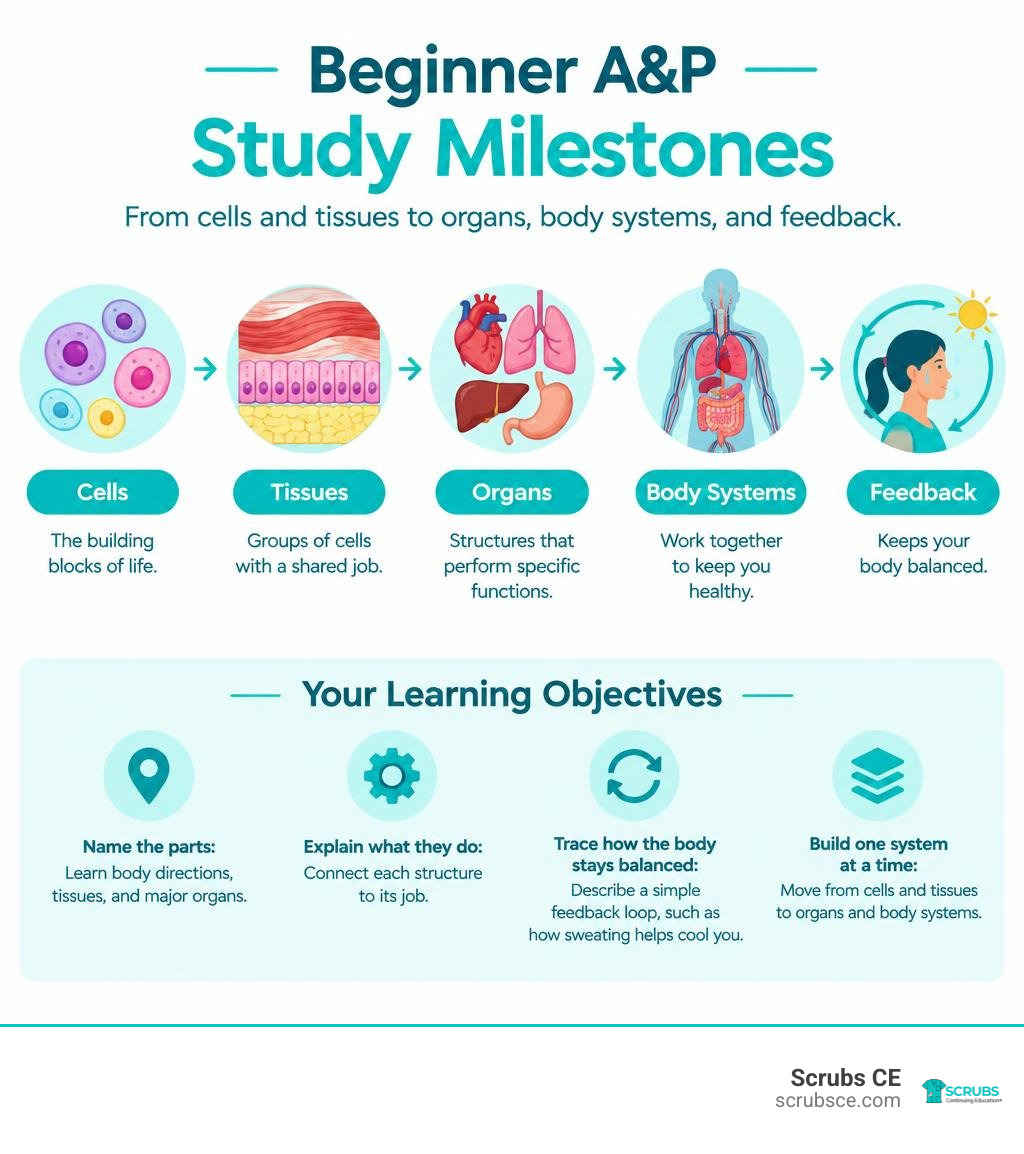
Use these anatomy and physiology for dummies learning objectives as a starting checklist:
- Name the parts: Learn body directions, tissues, and major organs.
- Explain what they do: Connect each structure to its job.
- Trace how the body stays balanced: Describe a simple feedback loop, such as how sweating helps cool you.
- Build one system at a time: Move from cells and tissues to organs and body systems.
These are study milestones, not a list of everything you must memorize. Check your course syllabus to see which details your instructor expects, then test yourself by labeling structures and explaining processes without looking at your notes.
I’m Zita Ewert, and I lead continuing education for imaging professionals at Scrubs CE. My experience making complex material easier to study shapes this guide to anatomy and physiology for dummies learning objectives.
Simple anatomy and physiology for dummies learning objectives glossary:
- anatomy and physiology for dummies
- anatomy and physiology for healthcare workers
- human anatomy and physiology for dummies
Why Anatomy and Physiology for Dummies Learning Objectives Matter for Beginners
Tackling human biology can feel like trying to drink from a firehose. With hundreds of bones, muscles, nerves, and microscopic pathways to track, students often feel overwhelmed within the first two weeks of class. That is why having structured benchmarks matters. When we break down complex topics into bite-size, manageable targets, we turn an intimidating subject into a clear roadmap.
Learning objectives act as your navigational compass. Instead of passively reading hundreds of pages and hoping the information sticks, objectives tell you exactly what skills to demonstrate. Whether you are understanding foundational human anatomy or preparing for professional clinical work, clear milestones distinguish the “need-to-know” essentials from background details.
| Study Dimension | Gross Anatomy Milestones | Systemic Physiology Milestones |
|---|---|---|
| Primary Focus | Physical structure, location, spatial relationships | Functional mechanisms, chemical signaling, balance |
| Key Verbs | Identify, label, locate, dissect, list | Explain, trace, compare, integrate, predict |
| Core Question | “Where is it and what does it look like?” | “How does it work and why does it happen?” |
| Assessment Style | Practical pin-tests, diagram labeling, spatial identification | Pathway mapping, case studies, physiological problem-solving |
| Study Methods | Flashcards, 3D anatomical models, root-word breakdown | Concept maps, feedback loop tracing, flowcharts |
Structure vs Function: Understanding the Dual Framework
A foundational concept in medical science is the principle of complementarity: structure determines function, and function reflects structure. Anatomy focuses on the physical components of the human body, from gross organs down to microscopic histology. Physiology explores how those structures perform vital dynamic processes to maintain life.
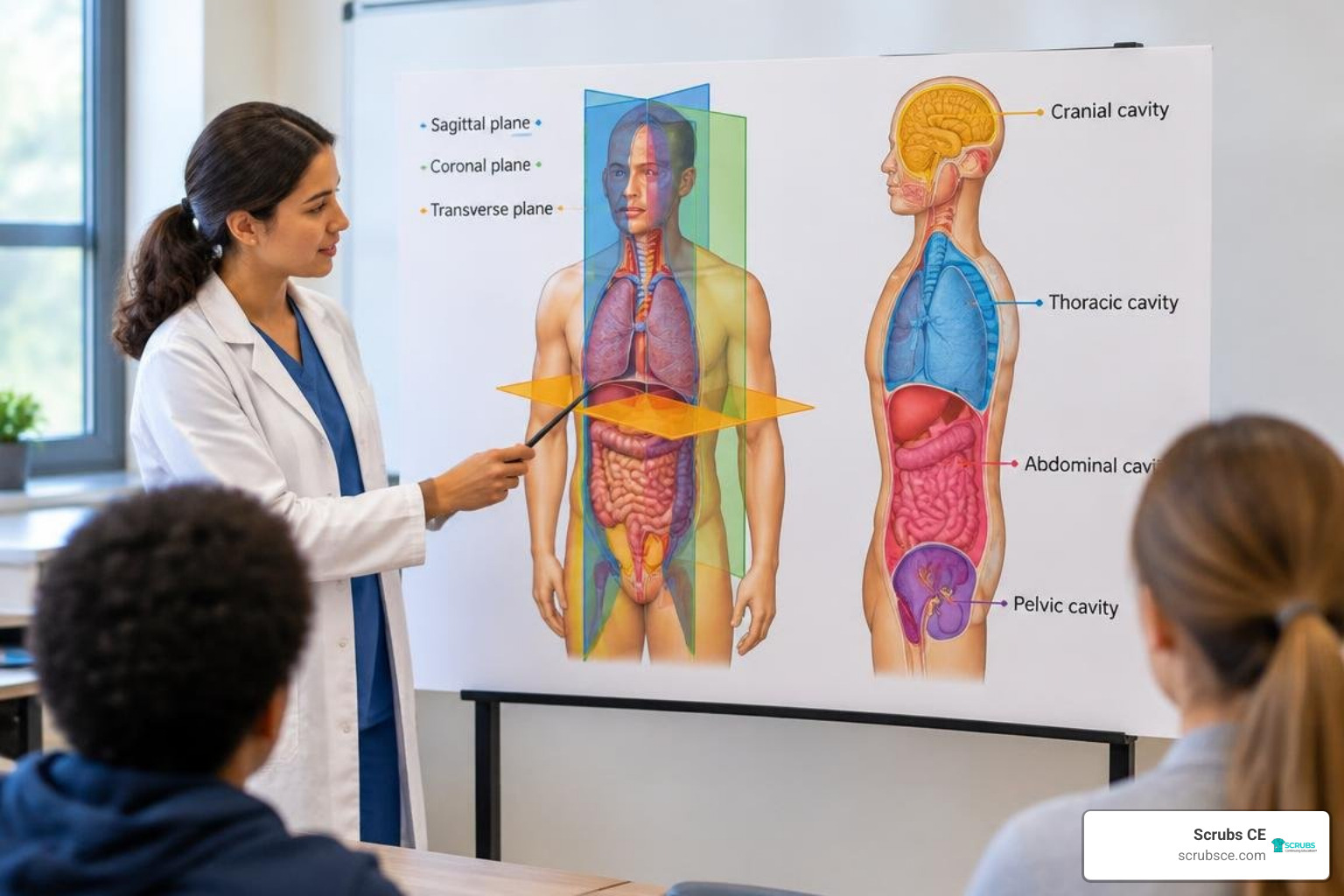
To make sense of both, we use standardized anatomical terminology. Directional terms (such as anterior, posterior, proximal, and distal) and anatomical planes (sagittal, frontal, and transverse) give healthcare providers a universal language. Learning this vocabulary is like adopting a body owner manual approach—it gives you the baseline coordinates to discuss health, disease, and medical interventions accurately.

Using Standardized Learning Objectives for Anatomy and Physiology for Dummies
Professional curricula across the country rely on standardized learning outcomes to maintain high educational standards. Educational bodies, such as the Human Anatomy and Physiology Society (HAPS), publish comprehensive outcome statements that guide textbook authors and college faculty. The HAPS A&P Learning Outcomes document contains over 800 statements organized into specific modules.
Because covering 800 detailed outcomes in two semesters is unrealistic for any beginner, instructors curate these lists. They select core goals and frame them using action verbs from Bloom’s taxonomy—such as identify, describe, differentiate, and evaluate. Recognizing these action verbs is a key strategy for simplifying concepts for healthcare workers, allowing students to focus their study time on the exact cognitive skills required for exams.
Core Course Modules and Milestone Breakdown Across Two Semesters

A standard undergraduate sequence divides human biology across two full terms. The majority of first-semester courses (A&P 1) tackle foundational chemistry, cells, tissues, and the structural framework of the body. Second-semester courses (A&P 2) focus on internal organ systems, metabolic integration, and fluid dynamics.
Standardized guidelines—such as the comprehensive HAPS outcomes revised in Fall 2019 and the physiology outcomes released in 2023—ensure that students build a progressive foundation. Let us look at how these milestones break down term by term.
Semester 1 Milestones: Cellular Foundations to Musculoskeletal Systems
The first semester provides the building blocks for understanding human biology:
- Chemical and Cellular Level: Understand atomic structure, chemical bonding, and water chemistry. Master cellular organelles, membrane transport (diffusion, osmosis, active transport), and cellular respiration.
- Histology: Differentiate the four primary tissue types—epithelial, connective, muscle, and nervous—and identify their subcategories under microscopic magnification.
- Integumentary System: Identify epidermal layers, dermal structures, accessory glands, and their roles in thermoregulation, protection, and vitamin D synthesis.
- Skeletal System: Learn axial and appendicular divisions, bone histology (osteoblasts, osteocytes, osteoclasts), joint classifications, and fracture healing. Reviewing skeletal system basics helps reinforce bone landmarks early.
- Muscular System: Trace excitation-contraction coupling at the neuromuscular junction, the sliding filament theory, motor unit recruitment, and major skeletal muscle groups.
- Nervous System & Senses: Master action potentials, synaptic transmission, central nervous system regions (brain and spinal cord), autonomic sympathetic/parasympathetic pathways, and special sensory organs.
Semester 2 Milestones: Visceral Systems, Regulation, and Integration
The second semester shifts toward complex regulation, transport mechanisms, and life cycles:
- Endocrine System: Differentiate steroid and peptide hormone signaling, hypothalamic-pituitary axes, and systemic endocrine feedback loops.
- Cardiovascular System: Trace blood flow through cardiac chambers and systemic circuits, understand electrical conduction on an ECG, and analyze blood pressure regulation.
- Lymphatics and Immunity: Master innate versus adaptive immunity, antibody production, lymphatic drainage, and pathogen defense. A quick crash course in lymphatic function provides a great primer on fluid filtration and immune surveillance.
- Respiratory System: Explain ventilation mechanics, lung volumes, gas diffusion across the alveolar-capillary membrane, and blood gas regulation.
- Digestive System and Metabolism: Trace nutrient passage through the gastrointestinal tract, enzyme digestion, nutrient absorption, and cellular metabolic pathways.
- Urinary and Fluid Balance: Explain nephron filtration, reabsorption, secretion, countercurrent multiplication, and systemic acid-base buffering.
- Reproductive System: Compare gametogenesis, hormonal regulation of ovarian and uterine cycles, fertilization, and basic embryological development.
How to Study and Differentiate Memorization from Conceptual Understanding
Success in anatomy and physiology requires balancing two distinct cognitive tasks: memorizing anatomical terminology and understanding dynamic physiological mechanisms. Attempting to memorize physiology through simple flashcards usually leads to confusion on exam day.
Using fast and flexible anatomy learning strategies helps you categorize information into distinct study workflows. Memorization builds your vocabulary; conceptual understanding lets you explain how those vocabulary terms interact in real time.
Aligning Anatomy and Physiology for Dummies Learning Objectives with Active Recall
To master anatomy, lean heavily on linguistic roots and active recall. Most anatomical names derive from Greek and Latin roots. For example, knowing that chondro means cartilage, osteo means bone, and myo means muscle lets you decipher unfamiliar terms on sight.
Pair these word roots with diagram labeling and self-quizzing. Rather than passively re-reading a textbook, cover the labels on anatomical diagrams and test your ability to write them from memory. For physiology, construct dynamic flowcharts that map cause-and-effect sequences—such as the renin-angiotensin-aldosterone system or cardiac cycle pressures. These active study techniques also build a strong baseline for imaging coursework, including radiographic anatomy principles.
Customizing Study Goals for Licensure and Professional Competencies
For students heading into healthcare careers, learning objectives are not just academic hurdles—they reflect professional standards. Licensing bodies, including the AMERICAN REGISTRY OF RADIOLOGIC TECHNOLOGISTS® (ARRT®), establish rigorous competency benchmarks that depend directly on foundational A&P mastery.
Meeting licensure test requirements requires demonstrating clinical application, such as predicting how a valve defect alters cardiac output or understanding patient positioning landmarks. Specialized fields, such as anatomy for radiographers, require professionals to bridge textbook anatomy with real-world clinical imaging.
Frequently Asked Questions About A&P Learning Objectives
How do comprehensive learning outcomes differ from standard textbook learning objectives?
Comprehensive learning outcomes (such as the 800+ statements published by HAPS) define the complete scope of knowledge across the entire discipline. Textbook learning objectives and course syllabi, by contrast, are curated selections tailored by instructors to fit specific credit limits, student backgrounds, and program goals.
How can beginners identify essential foundational objectives quickly?
Focus first on the core physiological themes: homeostatic feedback mechanisms, chemical transport across cell membranes, and the structural hierarchy from tissues to organs. Once you understand how a single cell functions and stays balanced, understanding complex organ systems becomes much easier.
What is the best strategy to balance memorization and conceptual physiology?
Use flashcards and spatial labeling apps for anatomical locations, bone markings, and muscle attachments. For physiology, switch to narrative explanations: teach the concept aloud to a peer or sketch step-by-step pathways on a whiteboard without consulting your textbook.
Conclusion
Mastering human anatomy and physiology is an achievable goal when you organize your studies around clear, milestone-driven objectives. By breaking large systems into digestible steps—from chemical and cellular basics to systemic integration—you build lasting knowledge and clinical confidence.
At Scrubs CE, we provide self-paced, high-quality continuing education courses to support your lifelong learning and career advancement. If you are ready to earn credits and reinforce your clinical knowledge, explore our Radiology continuing education course for Anatomy & Physiology for Dummies to complete your professional development milestones conveniently and affordably.